
Strict PFAS bans now threaten kitchen operations. Non-compliant non-stick griddles face customs confiscation, massive supply fines, and urgent restaurant recalls. You must replace prohibited fluoropolymer coatings immediately to protect your global food business.
Commercial kitchens achieve compliance by removing PTFE fluoropolymers and switching to certified ceramic, sol-gel, or pure stainless steel cooking surfaces. Importers must secure third-party test reports showing Total Organic Fluorine under 50 ppm, matching strict EU REACH updates and US state-level bans.
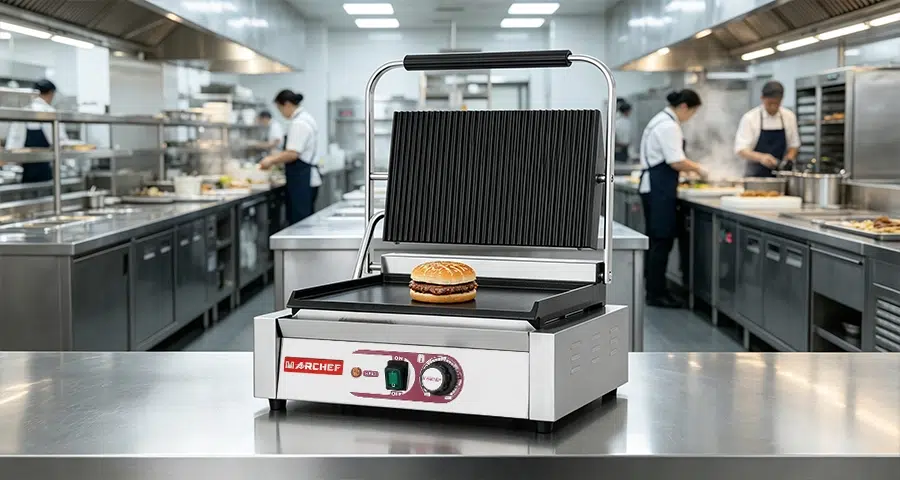
I learned this hard lesson when customs authorities temporarily held my shipment of non-stick panini grills at port last season. That expensive delay forced me to investigate every layer of surface chemistry across our manufacturing lines, and the operational reality is clear: legacy fluorinated coatings are becoming an immediate legal dead end for food equipment distributors worldwide.
The Regulatory Squeeze: How Do EU and US Laws Target Cooking Surfaces?
Commercial buyers face sudden border confiscations and heavy inventory fines today. New chemical bans actively outlaw traditional non-stick cooking plates. You cannot afford to ignore these joint regulatory deadlines.
Regulatory agencies target commercial cooking surfaces by measuring Total Organic Fluorine (TOF) levels. Any commercial equipment releasing fluorinated compounds into hot food violates modern contact rules, exposing distributors to cross-border penalties, product recalls, and strict retail liability under both European and American statutes.
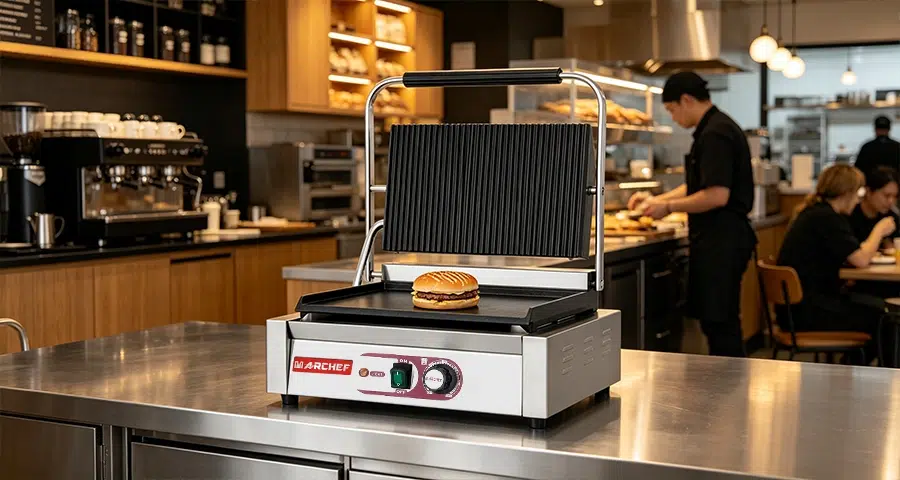
I had to sit down with our engineering teams to review international chemical laws. The regulatory landscape has shifted completely, and distributors can no longer treat non-stick coatings as harmless generic components.
EU REACH vs. US State-Level Bans: What Importers Must Know
The legal baseline differs sharply between continents. The European Union treats all fluoropolymers, including PTFE, under the proposed universal REACH restriction. This European framework targets individual substances down to 25 parts per billion, with total PFAS limits set at 250 parts per billion. The United States uses an aggressive state-level strategy instead of a single federal rule. States like California under AB 1200, Colorado under HB 1345, and Minnesota have placed complete prohibitions on intentionally added fluorochemicals. Most US jurisdictions trigger enforcement when Total Organic Fluorine exceeds 100 parts per million.
| Jurisdiction | Primary Legal Statute | Target Threshold | Scope of Food Equipment |
|---|---|---|---|
| European Union | EU REACH Universal Proposal | 25 ppb individual / 250 ppb sum | Commercial cooking platens, griddles, bakery pans |
| California, US | Assembly Bill 1200 | 100 ppm Total Organic Fluorine | Food contact surfaces and cookware |
| Minnesota, US | Amara’s Law | Zero intentionally added PFAS | Commercial foodservice components |
| Colorado, US | House Bill 1345 | 100 ppm Total Organic Fluorine | Commercial griddles, bakeware, release films |
Customs and Liability Risks for Foodservice Equipment Distributors
Distributors face immediate commercial exposure at the border. Customs agents now pull food-contact equipment for random laboratory screening, and a single positive fluorochemical hit results in immediate container rejections. The legal damage does not stop at the port. Commercial kitchen insurance companies now attach strict PFAS bodily injury exclusion clauses to standard liability policies. If an operator serves food cooked on non-compliant surfaces, standard insurance policies will not cover chemical exposure lawsuits. Distributors who supply uncertified cooking components carry total civil liability for any commercial recall, field retrofits, and equipment disposal costs.
Why Do Traditional PTFE Coatings Fail in High-Heat Chains?
Commercial kitchen lines run non-stick coatings under brutal continuous heat. The classic PTFE coatings blister, peel, and release invisible vapors during peak rush hours. You risk customer safety whenever these surfaces break down.
Traditional PTFE coatings fail because high-heat commercial cooktops run well above safe thermal thresholds. Normal surface contact over 200°C breaks down the molecular bonds, releasing fluorinated gases and dropping toxic microscopic coating flakes directly into customer food during high-volume cooking.
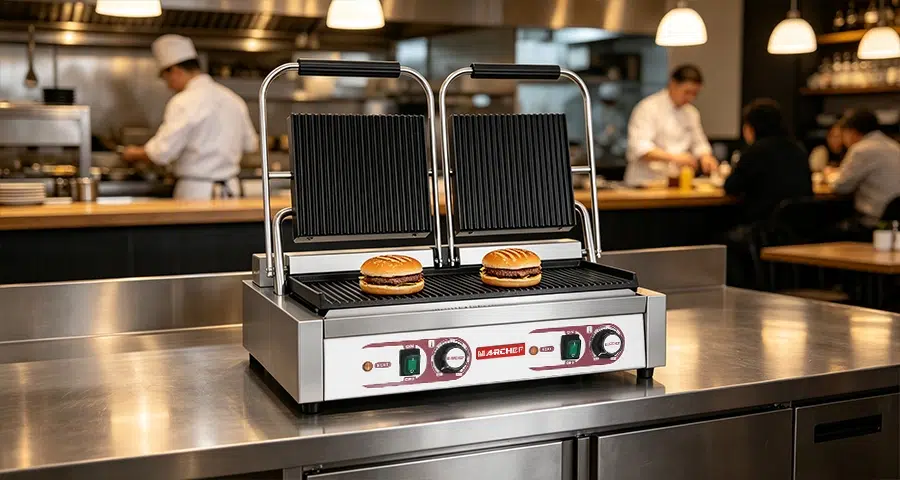
I inspected dozens of burned non-stick griddle plates returned from high-volume burger stations over the years. The failure pattern was always the same: intense heat and rough spatula use ruined the polymer within weeks.
Thermal Breakdown and Chemical Migration Above 200°C
Commercial burger platens, searing griddles, and high-speed panini presses operate between 200°C and 260°C. PTFE begins structural thermal degradation inside this exact operating window. The chemical bonds of the fluoropolymer weaken, causing toxic thermal degradation products to vaporize into the kitchen environment. The hot fats and acidic sauces break down the chemical matrix further, accelerating chemical migration into meat patties and grilled sandwiches. Kitchen staff breathe these vapors every day, and diners consume tiny chemical byproducts absorbed by the food during rapid high-heat contact.
Coating Flaking: The Operational Risk for High-Volume Brands
Fast-food lines rely on rigid stainless steel spatulas and rough wire cleaning pads. These metal utensils cause severe mechanical delamination on traditional PTFE release layers. The thin polymer layer loses adhesion to the metal base plate, creating micro-abrasions along the cook zone.
- Mechanical abrasion strips the microscopic non-stick skin from the plate.
- Loose black polymer flakes mix directly into the food stream.
- Diners notice black residue on toasted bread and grilled buns.
- Health inspectors cite the restaurant for direct foreign matter contamination.
- Brand trust collapses under viral customer reviews and public complaints.
Automated equipment faces this issue even faster. Continuous impingement oven conveyor belts and dual-sided clamshell platens wear through thin fluoropolymer layers within months of continuous service. Kitchen owners lose money through constant plate replacements, technician service calls, and lost production capacity during peak service hours.
How Can Buyers Source Certified PFAS-Free Equipment from Factories?
Sourcing compliant commercial kitchen gear feels overwhelming without clear benchmarks. Overseas factories often claim compliance while using hidden chemical additives. You must demand clear laboratory proof before wiring your deposit.
Buyers source compliant equipment by requiring verifiable NSF Guideline 537 certificates and independent European lab reports. Demand genuine sol-gel ceramic or inorganic plasma coatings with Total Organic Fluorine measured strictly below 50 ppm, and reject factories that rely on self-signed compliance letters.
When I audited our own production lines, I learned that checking factory paperwork on paper is never enough. We had to test our raw metal coatings in independent accredited labs to prove our equipment was completely clean.
Third-Party Testing and Documentation Checklist (FDA, NSF, EU)
Never accept simple factory declaration sheets. Importers must demand accredited third-party test reports showing Total Organic Fluorine content below 50 parts per million under NSF Guideline 537 protocols. The testing documentation must match international standards across all export markets.
| Compliance Standard | Testing Method | Target Threshold | Required Documentation |
|---|---|---|---|
| NSF Guideline 537 | Oxygen Bomb Combustion & Ion Chromatography | < 50 ppm Total Organic Fluorine | Formal NSF Listing Certificate |
| US FDA 21 CFR | Total Extractables Extraction Testing | Within FDA Migration Limits | ISO 17025 Accredited Lab Report |
| EU 1935/2004 | Target Liquid Chromatography (LC-MS/MS) | < 25 ppb Individual PFAS | EU Declaration of Compliance (DoC) |
| EU REACH Art. 33 | Total Fluorine by Combustion Ion Chromatography | < 250 ppb Total PFAS Sum | Third-Party Chemical Assay Report |
Avoiding Stranded Inventory and Non-Compliant Assets
Buyers must upgrade procurement contracts immediately to eliminate financial liabilities. Modern purchase contracts should include explicit indemnification clauses. If laboratory testing discovers hidden fluorochemicals during customs entry, the overseas factory must bear all shipping rejections, legal penalties, and replacement manufacturing costs.
Buyers should also focus procurement on permanent non-stick alternatives. Industrial plasma-applied ceramic-metallic hybrids and sol-gel inorganic silica coatings provide surface hardness ratings up to 9H. These advanced mineral coatings do not rely on fluorinated bonding aids, and they survive aggressive metal utensil contact during heavy kitchen shifts. Equipment distributors should source backwards-compatible, drop-in replacement plates for existing conveyor ovens and clamshell presses. This strategy keeps older machines running legally without forcing customers to buy entirely new appliances.
Conclusion
PFAS regulations permanently transform commercial food equipment markets. Buyers must audit their supply chains, enforce independent testing, and adopt certified non-stick alternatives today to protect their import operations.