
Are you losing money when customs holds your commercial kitchen equipment? Poorly built ovens fail safety checks fast. Let us look at the exact standards you need to know.
To pass strict US and EU safety checks, a commercial microwave must leak ≤1mW/cm² at the factory and pass 200,000 door hinge cycles. Buyers must also match wattage (800W–2100W) to kitchen volume and verify five core compliance documents before shipping.
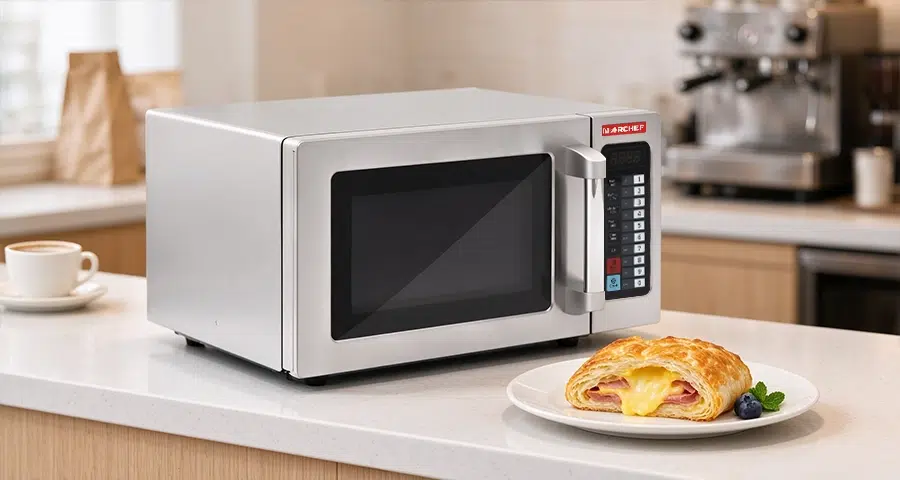
In my years running two kitchen equipment factories, I have seen many importers struggle with sudden border holds. You do not want your containers stuck at the port during your busiest sales season. Let me walk you through the real engineering facts behind safe, durable commercial microwaves so you can protect your business and keep your buyers happy.
Why Q4 US & EU Customs and OSHA Tighten Microwave Inspections?
Peak holiday shipping often brings sudden border delays and heavy storage fees. One missing radiation form can freeze your entire container. Here is how border agencies check your goods.
In the fourth quarter, US Customs and Border Protection (CBP) and EU market authorities increase automated risk targeting. US inspectors strictly check FDA Form 2877 for radiation declarations, while EU officials audit CE technical files, EMC, and LVD rules.
US Border and Workplace Rules
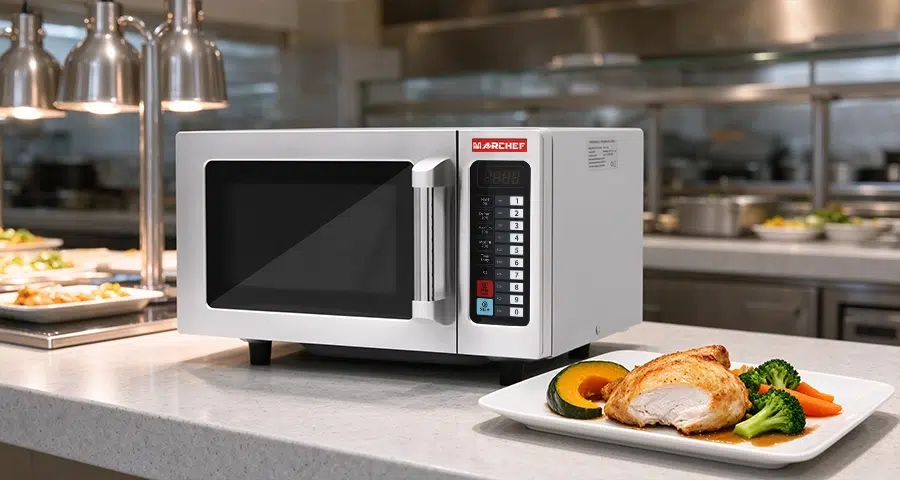
When I ship equipment overseas, I always remind my partners that customs is only the first hurdle. US CBP uses automated systems to flag high-volume Q4 imports. They check if your commercial microwave has a valid FDA Accession Number on Form 2877. Without this, your goods stop at the port. Even after the ovens reach a restaurant, OSHA inspectors check workplace safety. If an oven leaks radiation or lacks proper electrical marks like UL or ETL, the restaurant faces heavy fines. You must also show NSF/ANSI 4 sanitation approval for public foodservice use.
EU Market Surveillance Checks
In Europe, market surveillance teams actively pull commercial kitchen equipment from ports and warehouses during Q4. They check if the product truly meets IEC 60335-2-90 safety rules, along with RED and RoHS directives. Many buyers think a simple CE sticker is enough, but officials demand the full technical test file. If the file is missing or fake, they ban the product across the whole market.
| Region | Key Inspection Body | Primary Rules Enforced | Common Q4 Failure Point |
|---|---|---|---|
| United States | US CBP, FDA, OSHA | 21 CFR 1030.10, UL 923, NSF/ANSI 4 | Missing FDA Form 2877 or Accession Number |
| European Union | EU Market Surveillance | IEC 60335-2-90, EMC, LVD, RoHS | Incomplete CE technical construction file |
Microwave Leakage: Why ≤1mW/cm² Beats the 5mW/cm² Standard?
Microwave radiation leaks put kitchen staff at risk and trigger costly health inspector shutdowns. Cheaper ovens wear out fast and cross the legal limit. Here is why factory limits matter.
Under US FDA rule 21 CFR 1030.10, a new microwave must emit no more than 1 mW/cm² at 5 cm from its surface. Across its useful life, leakage cannot exceed 5 mW/cm². Starting at ≤1mW/cm² gives you a vital 4 mW/cm² safety buffer.
Understanding the 4 mW/cm² Safety Buffer
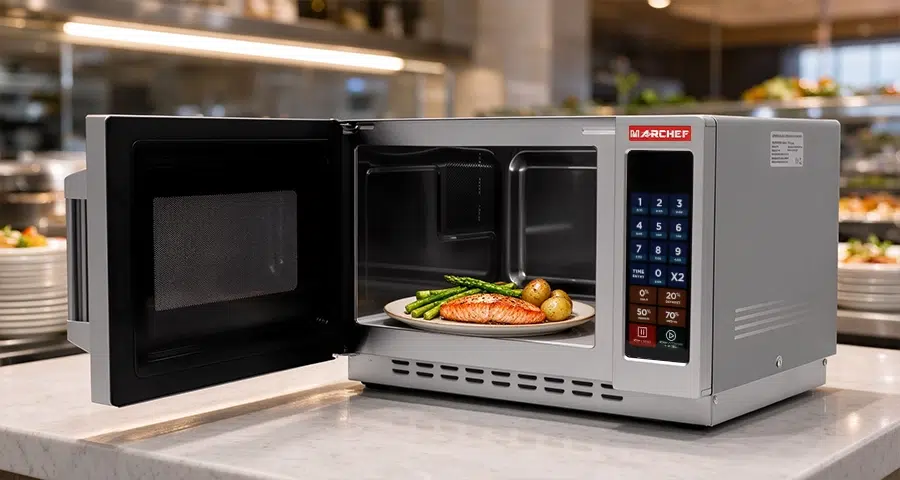
I once visited a busy fast-food chain where three ovens failed a local health check after just eight months. The problem was not the magnetron; it was the factory starting point. A commercial oven door opens and closes hundreds of times every day. Over time, door gaskets collect grease and metal hinges loosen slightly. If an oven leaves the factory leaking 3.5 mW/cm², it technically passes the 5 mW/cm² lifetime rule. However, normal daily wear will push it past 5 mW/cm² in a few months. By engineering our units at MARCHEF to leave the line at ≤1 mW/cm², we build in a huge 4 mW/cm² safety margin.
How Factory Calibration Prevents Leaks
Achieving ≤1 mW/cm² takes strict control over the door choke design and cavity welding. In our workshop, we test every single unit with calibrated leakage meters at a 5 cm distance before packing. We check the corners of the door, the viewing glass, and the vent slots. This ensures the oven stays safe for years, protecting your brand reputation from premature equipment failures.
| Leakage Benchmark | Measurement Distance | Legal Status | Real-World Impact for Buyers |
|---|---|---|---|
| ≤1 mW/cm² | 5 cm from surface | Factory release limit | Provides a 4 mW/cm² buffer against gasket wear |
| 1.1 – 4.9 mW/cm² | 5 cm from surface | Legal in-use limit | Narrow margin; high risk of failing future checks |
| ≥5 mW/cm² | 5 cm from surface | Illegal / Unsafe | Immediate OSHA citation or health shutdown |
Door Safety & Durability: Triple Interlocks & 200,000-Cycle Hinge Tests?
A broken door latch or weak hinge can expose workers to live microwave energy. Standard home-grade parts snap quickly in busy kitchens. Here is how heavy-duty doors stay safe.
IEC 60335-2-90 and UL 923 require at least two independent safety interlocks—including one monitored interlock—to cut magnetron power when the door opens. Heavy-duty commercial doors must also pass 200,000 open-and-close test cycles without exceeding leakage limits.
Why Triple Interlocks Save Lives
In a busy kitchen, staff often slam microwave doors shut with their elbows or hips. If the latch bends, the oven might try to run while the door is slightly open. International standards like UL 923 and IEC 60335-2-90 require at least two independent interlock switches, with one being concealed or monitored. We use a triple-interlock system on our commercial units. If the primary switch fails or a worker tries to bypass the latch, the monitored switch instantly trips a fuse and cuts power to the magnetron. It makes accidental radiation exposure impossible.
100,000 vs. 200,000 Hinge Cycles
Household microwaves are only tested to 100,000 door cycles because a family opens the door maybe ten times a day. A commercial restaurant opens that same door 200 times a day. At that pace, a 100,000-cycle hinge fails in just over a year. Heavy-duty commercial certification pushes door endurance to 200,000 cycles or more. During testing, machines slam the door 200,000 times, and engineers measure radiation leakage afterward. Only cast stainless steel hinges and reinforced latch hooks survive this without sagging.
| Feature | Light-Duty / Home Grade | Heavy-Duty Commercial Grade |
|---|---|---|
| Door Cycle Endurance | 100,000 cycles | 200,000+ cycles |
| Interlock System | Basic dual switch | Triple interlock with monitored safety switch |
| Hinge Material | Stamped thin sheet metal | Heavy cast stainless steel |
| Post-Test Leakage | Often degrades near 5 mW/cm² | Holds steady near ≤1 mW/cm² |
Choosing the Right Commercial Microwave Power (800W–2100W)?
Buying the wrong wattage leads to slow food prep or tripped circuit breakers in your customer’s kitchen. Output power and electrical draw are very different. Here is how to pick right.
Commercial microwave wattage matches kitchen volume: 800W–1000W fits light-duty cafés, 1200W–1800W serves busy restaurants, and 2100W dual-magnetron ovens handle rapid foodservice. Remember that advertised wattage is cooking output, meaning electrical input draw is much higher.
Output Power vs. Input Electrical Draw
One of the biggest mistakes I see buyers make is confusing cooking wattage with electrical plug requirements. Advertised wattage only measures the cooking power inside the cavity. An 800W to 1000W oven actually pulls 1200W to 1500W from the wall outlet, which works fine on standard 110V or 220V single-phase lines. However, a 2100W commercial oven draws around 3000W to 3200W of electrical power. It requires a dedicated 208V–240V high-amperage circuit. If a kitchen plugs a 2100W unit into a weak circuit, the breaker trips immediately.
Dual-Feed Antennas vs. Glass Turntables
Light-duty 1000W units often use rotating glass turntables, which break easily and cannot hold square trays. Once you step up to heavy-duty 1800W and 2100W models, we remove the turntable completely. Instead, we build top-and-bottom dual-feed antenna systems. Two magnetrons push energy from both above and below the food. This cooks food evenly without moving