
Slime and scale block your commercial ice makers constantly. This downtime destroys your daily restaurant profits and frustrates your kitchen staff. You can fix this machine failure by understanding the underlying mechanics.
Serratia marcescens and evaporator scale ruin commercial ice makers by forming tough biofilms and rough mineral layers. These issues cause ice to stick to the evaporator, block the harvest cycle, and trigger complete compressor failure. Proper water filtration and automated cleaning sequences can prevent these costly breakdowns.
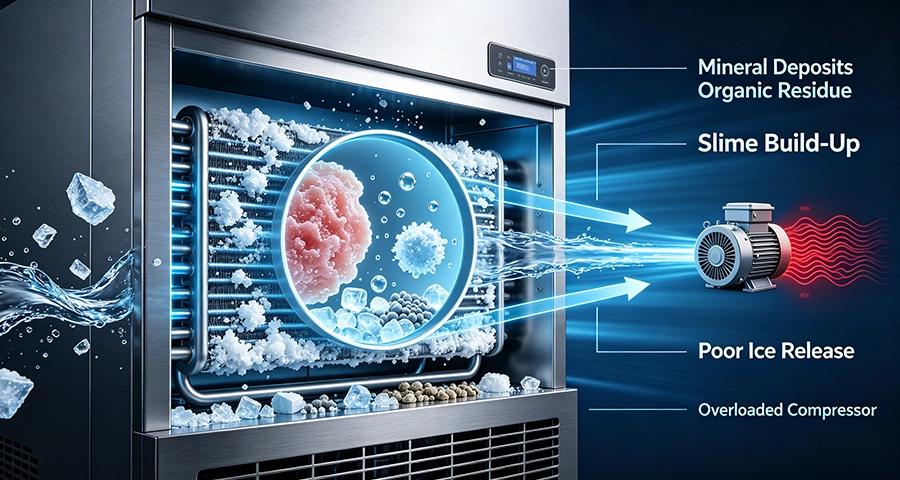
I see many distributors face these hidden technical problems every year. If you want to stop wasting money on constant field repairs and part replacements, you must read further to see how these two elements destroy your refrigeration equipment from the inside out.
How Do You Identify the Enemy Between Pink Slime and Common Mold?
Slimy pink layers ruin your ice quality fast. This contamination scares your customers away and damages your business reputation. You can easily spot the difference by studying how bacteria grow.
Pink slime is actually a bacterium called Serratia marcescens, not a mold. It feeds on airborne yeast, starch, and alcohol vapors in kitchens. It forms a thick biofilm layer that shields itself from normal chlorine washes while using a pink pigment to stick tightly to parts.
Atmospheric Conditions: Moisture, Airflow, and Airborne Yeast Formulations
I run my own refrigeration factories, and I know this bacteria loves commercial kitchens. Bakeries and breweries have lots of airborne yeast, lipids, and ethanol formulations. The ice machine fan pulls these food particles inside the food zone. Serratia marcescens eats these particles and thrives fast in the wet, dark environment. It does not grow like normal mold. It needs specific air conditions to start its growth cycle.
How Biofilms Protect Bacteria from Standard Chlorine Rinses
The bacteria creates an extracellular polymeric substance matrix once it settles on a surface. We call this an EPS matrix. This matrix acts like a dense shield. Standard chlorine rinses cannot break this shield at normal concentrations. The bacteria also makes a special secondary pigment. We call it prodigiosin. This pigment gives the slime its bright pink color. The pigment is hydrophobic, so it does not like water. It helps the bacteria stick very hard to plastic and metallic water paths. You cannot wash it away with a simple water flush.
| Component | Biological Action | Impact on Machine |
|---|---|---|
| EPS Matrix | Creates a dense slime shield | Blocks chlorine from killing bacteria |
| Prodigiosin | Synthesizes a pink hydrophobic pigment | Sticks bacteria tightly to internal walls |
What Is the Chemistry of Scale Accumulation on Evaporator Surfaces?
Hard water scale coats your evaporator plates silently. This mineral layer slows down your ice production and increases your electricity bills. You can stop this buildup by looking at the chemical reaction.
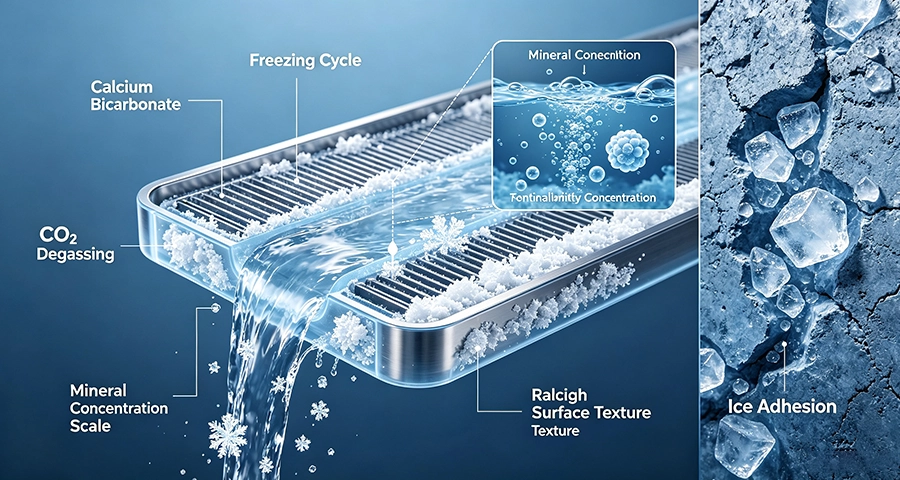
Evaporator scale forms when dissolved calcium bicarbonate breaks down during the freezing cycle. Pure water freezes first, which concentrates the minerals until they precipitate as hard calcium carbonate. This scale changes the surface roughness, creating a strong mechanical bond that makes the ice stick.
Thermal Dissociation of Calcium Bicarbonate During the Freeze Cycle
I always tell my factory engineers to study water chemistry deeply. Water contains dissolved calcium bicarbonate. During the freeze cycle, the machine pumps water over the cold evaporator plate. Pure water turns into ice crystals first. This means the remaining water keeps more minerals. The mineral concentration rises very fast in the sump tank. At the same time, carbon dioxide gas escapes from the water. This degassing changes the chemical balance. The dissolved calcium bicarbonate undergoes thermal dissociation. It turns into insoluble calcium carbonate scale right at the heat transfer interface.
Surface Roughness: How Scale Creates the Perfect Anchor for Mechanical Bonding (Ice Sticking)
This scale deposits directly onto the evaporator plate surface. The scale changes the microscopic surface roughness of the metal plate. It introduces tiny physical voids and rough micro-textures. When water freezes in the next cycle, the new ice fills these tiny holes. It creates a powerful mechanical bond. This bond locks the ice to the plate. The ice sheet sticks and cannot slide off during normal operation.
| Phase | Chemical Process | Physical Result |
|---|---|---|
| Freeze Cycle | Carbon dioxide degassing occurs | Calcium bicarbonate breaks down |
| Scale Deposition | Insoluble calcium carbonate forms | Surface roughness increases with micro-textures |
How Does Evaporator Freeze-Up Cause Total System Failure?
Stuck ice blocks the normal cycle of your machine. This issue creates a massive ice block that crushes your internal parts. You can avoid expensive repairs by understanding the physics of freeze-up.
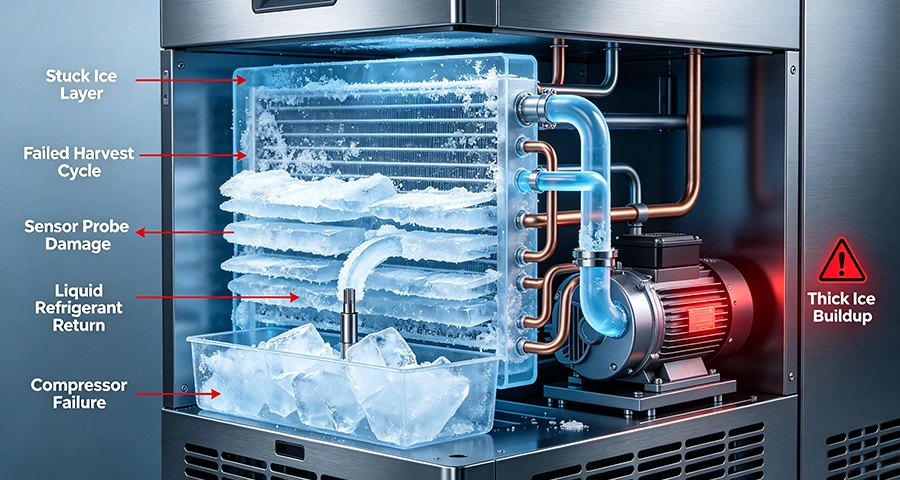
An ice machine freeze-up happens when an ice sheet sticks during the harvest cycle, causing new ice to freeze over it. This block damages thickness sensors and stops refrigerant from vaporizing, which sends liquid refrigerant back to the compressor and causes total mechanical failure.
Why the Harvest Cycle Fails When Ice Refuses to Release
I see this failure often in poorly maintained kitchens. During the harvest cycle, the machine sends hot gas to warm the evaporator plate. The ice should drop into the bin. But the rough scale holds the ice sheet tight. The ice refuses to release. The machine does not know the ice is still there because the harvest sensor fails. It starts a new freeze cycle anyway. The water pump pours fresh water over the unreleased ice slab. This creates a compounding freeze-up. New ice layers freeze right over the old ice. The ice block grows larger and heavier.
How Evaporator Freeze-Up Damages Compressors and Sensor Probes
This heavy block puts immense physical pressure on the internal components. It bends and breaks the harvest sensor probes and ice thickness curtains. The massive ice layer also insulates the evaporator plate. The liquid refrigerant inside the tubes cannot absorb heat from the water. It cannot vaporize into gas. It flows back to the compressor as a liquid. This liquid floodback dilutes the compressor oil. It scores the cylinders and causes a terminal mechanical seizure.
| Component | Type of Damage | Final Outcome |
|---|---|---|
| Sensor Probes | Physical bending from ice | Electronic calibration fails |
| Compressor | Liquid refrigerant floodback | Oil dilution and mechanical seizure |
Can Engineering Solutions Mitigate Slime and Scale at the Design Level?
Manual cleaning takes too much time and labor costs. If your machines lack smart design features, scale and slime will return quickly. You can solve this permanently by choosing engineered cleaning systems.
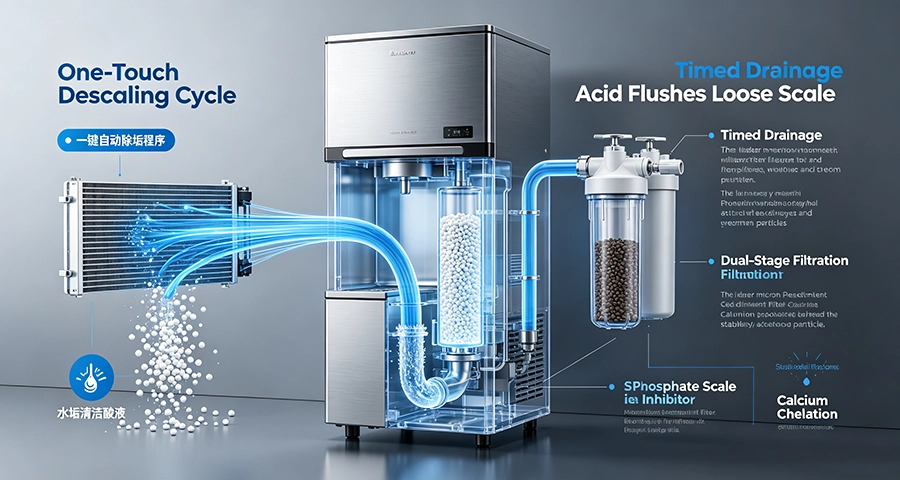
We can mitigate slime and scale at the design level by using automated descaling sequences and dual-stage water filtration. Automated systems flush away loosened minerals systematically, while dual-stage filters combine sediment removal with polyphosphate chemicals to stop hardness minerals from precipitating.
Automated Descaling Sequences (One-Button Cleaning Systems)
In my factory, we focus on engineering answers to these problems. We build automated descaling sequences into our refrigeration equipment. This is a simple one-button cleaning system. When a worker presses the button, the machine adjusts its water pump circulation patterns. It pumps cleaning acid through the system for a precise time. This acid loosens the mineral layers. Then, the machine uses timed drainage sequences to flush the loose scale away completely.
Dual-Stage Water Filtration: Sediment Removal + Scale Inhibition
To stop the problem before it starts, we use dual-stage water filtration. The first stage has a sub-micron sediment depth filter. This filter removes physical dirt, rust, and airborne yeast cells. The second stage uses polyphosphate scale inhibitors. These chemicals mix with the water. They chemically bind with the hardness minerals. This process sequesters the calcium. It stops the minerals from sticking together. The calcium cannot precipitate onto the metal plate. This dual method stops both biological slime and chemical scale.
| Solution Level | Mechanical Action | Operational Benefit |
|---|---|---|
| Automated Flush | Changes pump patterns with acid | Removes existing scale automatically |
| Dual Filtration | Uses sub-micron filter and polyphosphates | Stops yeast and sequesters calcium |
Conclusion
Pink slime and scale cause serious ice maker failures, but you can protect your business by using dual-stage filtration, automated cleaning, and high-quality refrigeration equipment.