
Buyers often freeze when picking between gas and electric griddles. This delay kills business efficiency. You need simple facts to help them make the right choice right now.
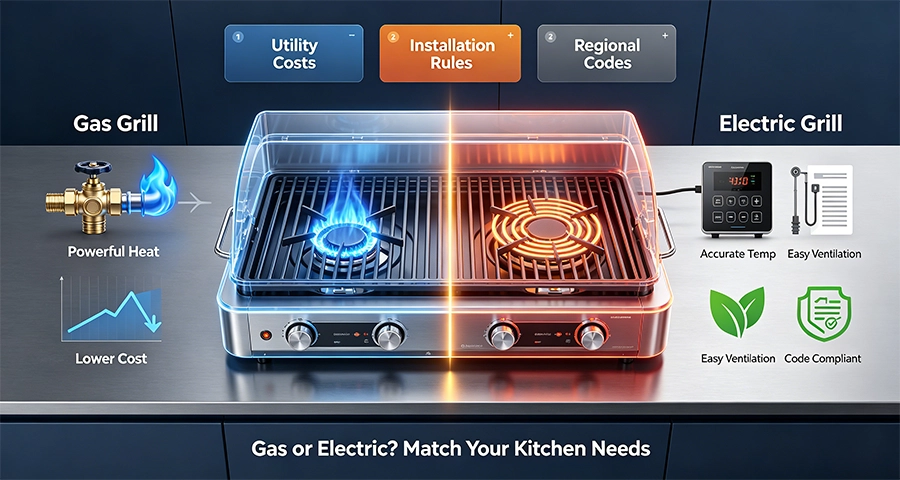
The choice between gas and electric countertop griddles depends on utility rates, installation limits, and regional codes. Gas models deliver raw power and lower running costs. Electric models offer precise temperature control, require less ventilation, and meet new green building laws in Europe and North America.
I have spent years working with commercial kitchen equipment. I want to share what really matters to end-users so you can understand this equipment better.
Energy Efficiency vs. Power: Analyzing Long-Term Operational Costs?
High energy bills destroy restaurant profits. If a kitchen uses the wrong griddle, owners lose money every day. You must understand long-term energy expenses completely.
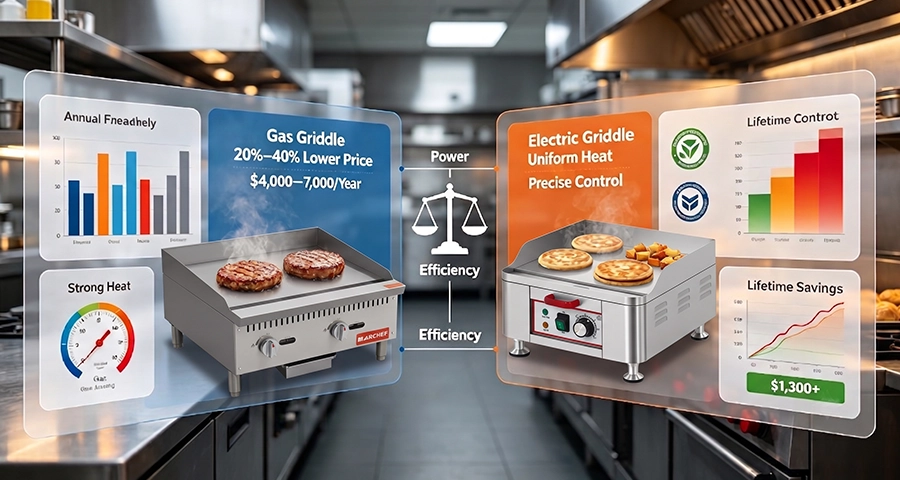
Gas commercial griddles cost much less to run at peak output. They create a $4,000 to $7,000 annual energy savings for busy kitchens. However, ENERGY STAR-certified electric griddles save operators over $1,300 in lifetime energy costs, which offsets their higher initial price.
Understanding the Real Cost of Cooking
People always look at the first price tag. Gas griddles usually have a 20% to 40% lower upfront purchase price than electric models. This looks great at first glance. But you must also look at the daily running costs. Gas is cheaper in many cities. A very busy diner will save thousands of dollars a year with a gas unit.
On the other hand, electric griddle plates offer superior temperature uniformity. Their heating elements cover the full width of the plate. This design avoids the localized hot spots that are common around gas burners. I once saw a diner burn half their pancakes because of gas hot spots. This waste adds up quickly. You must balance raw power against exact heat.
| Feature | Gas Griddles | Electric Griddles |
|---|---|---|
| Initial Price | 20% to 40% lower | Higher starting cost |
| Energy Savings | Saves $4k-$7k per year | Saves >$1,300 over lifetime |
| Heat Distribution | Good, but has hot spots | Excellent and very even |
| Best Kitchen Use | High-volume, fast cooking | Precise cooking and baking |
Always check the specific menu of the kitchen. A burger joint needs raw power. A bakery needs perfect heat control.
The Hidden Costs of Installation: Ventilation Hoods and Gas Lines?
Kitchen installations often go over budget. Hidden plumbing and ventilation costs surprise many owners. You must know these installation limits before picking a machine.
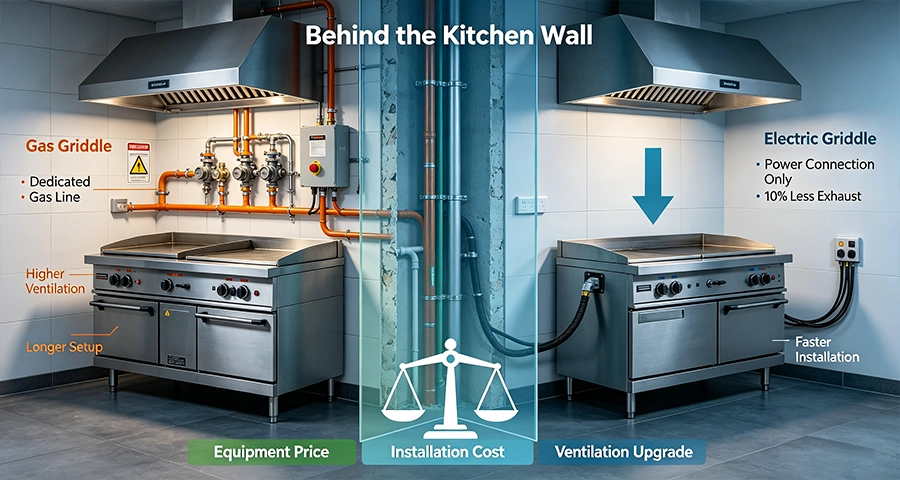
Gas griddles require the installation of dedicated gas plumbing, which is expensive. Electric griddles require about 10% less exhaust flow rate under custom-engineered backshelf hoods compared to gas. This difference greatly reduces the operational load on a kitchen’s HVAC system.
What Happens Behind the Kitchen Walls
People often forget about installation costs. They focus only on the equipment. But setting up a commercial kitchen involves strict building codes. If someone buys a gas griddle, they must hire a professional to put in gas lines. This step is a massive hidden cost. It also takes a lot of time.
In contrast, electric griddles are simpler to set up. You just wire them to the correct power source. You also need to think about air quality. Gas makes more heat and creates exhaust. The kitchen needs a very powerful ventilation hood. Electric units run cleaner. Saving 10% on exhaust flow saves a lot of money on the HVAC system. I recall a project where switching to electric saved the owner from upgrading their entire roof fan system.
| Installation Factor | Gas Griddles | Electric Griddles |
|---|---|---|
| Power Source Setup | Needs dedicated gas pipes | Needs heavy electrical wiring |
| Ventilation Needs | High exhaust flow required | 10% less exhaust flow needed |
| HVAC Load | Adds heavy heat to space | Adds less heat to space |
| Setup Speed | Slow, needs strict safety checks | Fast, connects to power directly |
You must look at the kitchen space first. A cheap gas griddle becomes very expensive if you must rebuild the whole air system.
Navigating CE, UL, and NSF Certifications for EU & NA Markets?
Uncertified equipment gets seized at customs. Using illegal machines ruins a business completely. You must understand the correct local safety marks for every region.
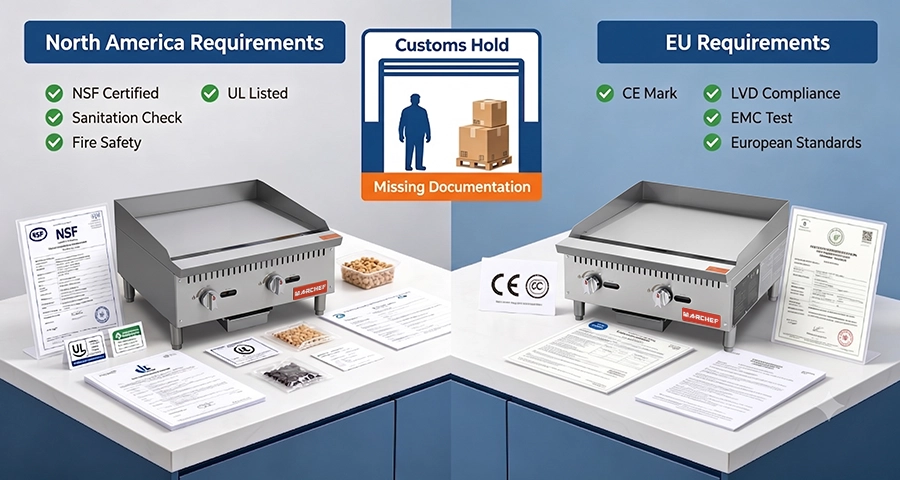
North American codes mandate NSF certification for food-contact sanitation and UL certification for safety. To sell in the European Union, equipment needs the CE mark. This requires passing Electromagnetic Compatibility (EMC) and Low Voltage Directives, which North American UL testing does not cover.
The Rules You Cannot Break
Certifications are not just random stickers. They are strict laws. For the US and Canada markets, you must have UL and NSF. Health inspectors will close a kitchen quickly if the griddle lacks an NSF mark. The NSF mark proves the machine is easy to clean and safe for food. The UL mark proves the machine will not cause a fire.
Europe uses completely different rules. Buyers there only want the CE mark. The CE mark proves the machine meets European safety, health, and green standards. The EMC test is very strict. It ensures the machine does not interfere with other electronic devices nearby. I have seen shipments delayed for weeks because they lacked the proper EMC paperwork.
| Market Region | Required Mark | Focus Area |
|---|---|---|
| North America | NSF | Food contact and easy cleaning |
| North America | UL | Electrical safety and fire prevention |
| European Union | CE (Low Voltage) | Safe electrical usage |
| European Union | CE (EMC) | No electronic interference |
You must know these differences well. One certificate does not work everywhere. Always verify the real test papers before trusting any equipment.
Maintenance and Durability: Reducing Downtime in Commercial Kitchens?
Broken equipment stops food service immediately. Kitchen staff get angry when machines fail during busy hours. You need reliable machines that do not break down often.
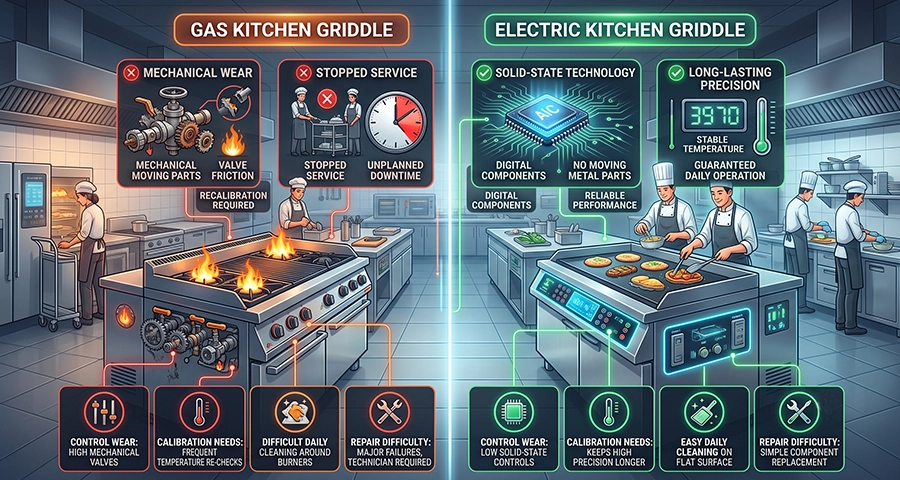
Solid-state thermostatic controls on electric griddles experience much less mechanical wear than traditional snap-action gas valves. This reduces the frequency of mandatory temperature recalibrations and stops unscheduled maintenance downtime. Gas griddles require more frequent check-ups because of their moving parts.
Keeping the Kitchen Running Every Day
Machine downtime is a commercial kitchen’s worst enemy. If the griddle breaks, the restaurant cannot make food. Gas griddles use mechanical valves. These snap-action valves open and close constantly to manage the flame. Over time, this metal wears out. You must call a technician to fix or calibrate them. This process costs time and money.
Electric griddles operate differently. Modern electric units use solid-state thermostatic controls. These are digital parts. They have no moving metal pieces. They do not wear out easily. They stay highly accurate for a very long time. I remember a time when a simple worn gas valve shut down a busy diner for a whole weekend.
| Maintenance Type | Gas Griddles | Electric Griddles |
|---|---|---|
| Control Wear | High due to mechanical valves | Low due to solid-state controls |
| Calibration Needs | Needs frequent temperature checks | Stays accurate much longer |
| Daily Cleaning | Harder around burners and grates | Easier on the flat surface underneath |
| Repair Difficulty | Can be high, needs specialist | Often simpler with part swaps |
Electric machines might seem costly at first. But they save many maintenance headaches later.
Stocking Strategy: Which Griddle Type Should Distributors Prioritize?
Dead stock in a warehouse wastes money. Guessing what the market wants causes heavy losses. You need a smart stocking strategy to keep your business moving.
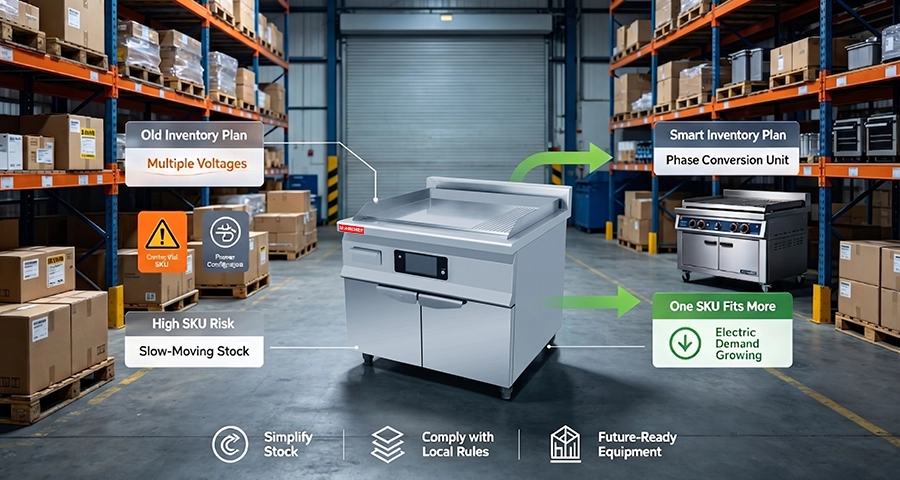
Distributors can reduce inventory complexity by prioritizing phase-convertible electric griddles. These units satisfy many urban power constraints with a single SKU. Furthermore, European decarbonization policies and natural gas phase-outs are shifting buyer demand heavily toward high-efficiency electric and induction technologies.
Building a Smart and Simple Inventory
You want to hold the right items in a warehouse. Too many choices create chaos. You want one product that fits many different buyers. Right now, the world is changing very fast. Europe has aggressive decarbonization policies. Many local governments ban new natural gas lines in newly constructed commercial buildings. Because of this rule, demand is moving fast toward electric griddles.
The best trick is to prioritize phase-convertible electric griddles. This means the exact same machine can run on different power setups. You do not need to stock three different models. You just stock one single SKU. This makes inventory simple and keeps cash free. I learned this lesson early on. Stocking versatile units prevents you from getting stuck with unsellable gas machines in regions with new green laws.
| Market Trend | Old Stocking Plan | Smart Stocking Plan |
|---|---|---|
| Power Limits | Stocking many voltage types | Stocking phase-convertible units |
| Green Laws | Buying gas machines | Buying electric and induction |
| Inventory Risk | High due to many SKUs | Low due to versatile SKUs |
| Sales Speed | Slows down in modern urban areas | Fast, fits new buildings easily |
Keep inventory simple. Follow local laws, follow the trends, and focus on versatile electric machines for the future.
Conclusion
Choosing between gas and electric griddles relies on long-term costs, safety rules, and green laws. Prioritizing versatile electric models meets future demands and simplifies operations.