
Kitchen orders stop when commercial griddles refuse to ignite during peak rush hours. Lost tickets and cold cooktops frustrate cooks, while line delays damage daily restaurant revenue.
You can fix most commercial griddle ignition and gas valve issues by clearing grease paths, cleaning carbon off thermocouple tips, and replacing galled valve stems. Proper gas line pressure and clean orifices restore safe ignition fast.
I see restaurant chains face these mechanical breakdowns every week in commercial kitchens. Let us examine the exact causes and step-by-step diagnostic solutions below.
What Are the Common Symptoms of Commercial Griddle Ignition and Gas Valve Failure?
Flickering pilot lights and stiff control knobs slow down kitchen operations during morning prep. Ignoring these small ignition warnings leads to complete cooktop shutdowns during rush hours.
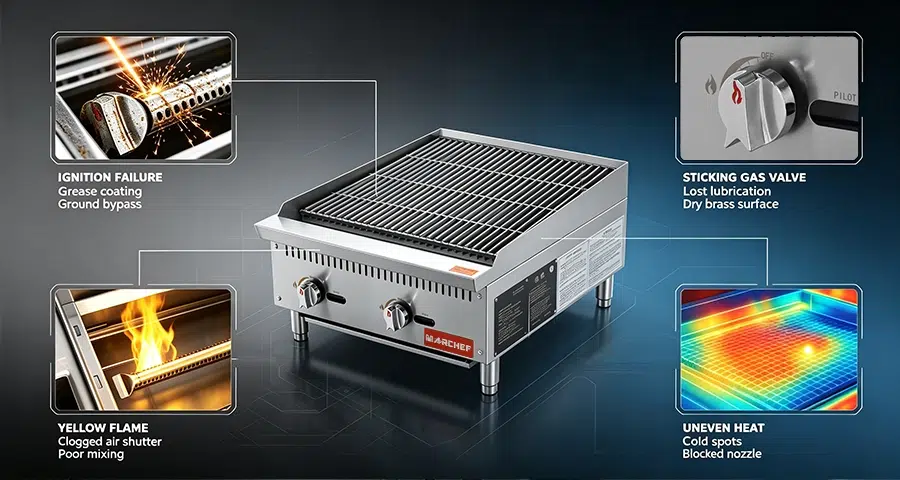
Common griddle failure symptoms include missed spark ignition, stiff control knobs, yellow lazy burner flames, and rapid heat loss. These issues stem from heavy grease deposits, carbon buildup on sensors, and degraded valve lubricants.
Piezo vs. Electronic Spark Igniters: Why Heavy Grease Causes Missed Sparks
I inspect many faulty griddles during service visits, and electrical grounding is the main reason sparks fail. Liquid grease drips past the griddle plate and coats the ceramic insulator collar around the piezo pin. This wet grease layer creates a conductive bypass path directly to the steel chassis. The electrical charge grounds out before the spark can bridge the gap across the burner port. Electronic spark systems also suffer when silicone lead wires degrade under high grease-tray heat. These heat fractures break the ground return path beneath the grease tray.
Sticky or Jammed Gas Valves: High-Heat Grease Ingress vs. Internal Spring Wear
Many operators believe internal spring failure causes stiff gas knobs, but this is rarely true. Continuous heat breaks down the factory lubricant inside the brass valve body. Hot cooking grease then enters the valve stem channel and washes away the remaining high-temperature grease. This leaves dry brass surfaces rubbing against each other. When metal-to-metal galling begins, the valve stem binds tightly. Forcing the knob by hand strips the internal seal and creates dangerous gas leaks.
Uneven Flame Patterns & Inconsistent Surface Temperatures Across Burners
Yellow, lazy burner flames show an improper fuel-to-air mixture rather than total valve failure. Grease and kitchen dust block the primary air shutter openings near the front manifold. At the same time, partially clogged brass orifices restrict gas velocity. This blockage starves the griddle plate of heat and creates distinct cold spots across the cooking surface. In liquid propane griddles, heavy-end hydrocarbons collect in the valve seat twice as fast as natural gas units due to cold expansion drops.
| Symptom Observed | Root Mechanical Cause | Direct Operational Impact |
|---|---|---|
| No Spark at Burner | Grease bridges ceramic collar to chassis | Total ignition failure; gas pools in box |
| Pilot Flame Drops Out | Carbon crust insulates thermocouple probe | Safety valve shuts off main gas supply |
| Stiff Control Knob | Lubricant breakdown and metal galling | Valve jam; risk of gas stem leakage |
| Yellow Lazy Flames | Blocked air shutter or clogged orifice | Cold zones; poor cooking performance |
How Should Line Cooks Follow a Step-by-Step Diagnostic and Maintenance Guide?
Unsafe gas troubleshooting puts kitchen staff and restaurant property at high risk. Untrained staff often damage sensitive burner components when trying to clean stubborn soot deposits.
Line cooks can safely maintain griddles by using soft brass brushes on igniter pins, clearing orifices with soft monofilament lines, and testing line gas pressure before calling external repair technicians.
Safely Cleaning Grease-Clogged Igniter Pins and Thermocouple Tips
I always teach technicians to inspect the thermocouple tip first. Carbon soot forms an insulating crust over the probe tip during daily cooking shifts. This soot layer prevents flame heat from reaching the internal junction, so millivolt output drops below the safety hold-in threshold. The automatic safety valve then snaps shut. Cooks should clean the probe tip and spark pin using a non-metallic abrasive pad or soft brass wire brush. Never strike the ceramic sleeve, because tiny hairline cracks ruin the spark path instantly.
How to Check Gas Valve Orifices for Carbon Buildup and Blockages
When cleaning clogged brass orifices, many cooks use hardened steel picks or large drill bits. This is a severe mistake. Steel tools widen the soft brass orifice hole. Enlarging the opening changes the fuel-air balance, which causes yellow sooting and flame lifting. Instead, use compressed air or a soft nylon monofilament line to push debris out of the orifice. Always remove the brass orifice from the manifold before cleaning so debris does not fall deeper into the burner tube.
Testing Gas Pressure and Line Connections Before Calling a Service Tech
Before you order replacement parts, verify incoming gas supply pressure with a basic manometer. Commercial griddles require steady operating pressure to maintain strong blue flames across all burners. Inspect the thermal capillary tubes attached to modulating thermostat valves. If someone pinches this copper tube during griddle plate cleaning, the fluid cannot expand properly. This pinch causes severe thermostat calibration drift.
| Maintenance Step | Correct Tool to Use | Common Mistake to Avoid |
|---|---|---|
| Igniter & Sensor Cleaning | Brass brush or nylon pad | Steel files that scratch metal |
| Orifice Clearing | Compressed air or nylon line | Hard steel picks or drill bits |
| Leak Testing | Approved non-corrosive bubble solution | Open flame or soap with ammonia |
| Capillary Inspection | Visual clearance check | Bending or pinching the copper line |
When Should High-Volume Chain Restaurants Repair or Replace Griddle Components?
A broken griddle shuts down burger and breakfast lines instantly. Kitchen managers waste money on repeated field repairs when the entire valve assembly has already failed mechanically.
Replace the entire valve assembly when the valve stem galls or turns stiffly under normal hand force. High-volume kitchens save money by replacing complete modular assemblies instead of rebuilding worn individual parts.
Calculating Downtime Costs During Peak Kitchen Hours
When a four-foot griddle fails during lunch rush, an active kitchen loses significant ticket sales every hour. In my experience working with restaurant chains, emergency technician call-out fees cost more than standard replacement parts. A line cook waiting for a service van wastes paid kitchen labor hours. Field repairs that only patch a damaged valve often fail again within thirty days. Replacing the full assembly returns the cooking station to service immediately.
When Valve Stiffening Indicates Imminent Safety Hazard & Requires Full Valve Assembly Replacement
If a gas valve knob resists normal hand turning, do not apply spray lubricants into the stem. Spray lubricants wash away high-temperature grease and create fire hazards behind the front panel. A stiff valve stem means the brass housing has suffered metal-to-metal galling or seal failure. Once metal galling begins, field grease cannot restore a gas-tight seal. Kitchen managers must replace the entire valve body immediately to avoid gas leaks inside the chassis.
Establishing Preventive Maintenance Schedules to Prevent Kitchen Bottlenecks
Chain restaurants need strict preventive maintenance schedules to protect their equipment investments. Monthly maintenance checks must include testing thermocouple millivolt output, wiping igniter ceramics clean of grease, and checking flame stability. Quarterly inspections should test thermostat calibration and gas pressure under full kitchen load. Stocking complete modular valve assemblies at each store reduces repair downtime from days to less than one hour.
| Component Condition | Recommended Action | Downtime Impact |
|---|---|---|
| Light Carbon on Sensor | Clean probe with brass brush | 5 minutes; zero lost sales |
| Grease on Ceramic Pin | Degrease ceramic sleeve with solvent | 10 minutes; quick recovery |
| Stiff or Galled Valve Stem | Replace complete valve assembly | 45 minutes; prevents gas leaks |
| Pinched Capillary Tube | Replace thermostat valve unit | 40 minutes; restores temperature control |
What Features Should Equipment Distributors Look for When Sourcing Durable Griddle Components?
Supplying low-quality griddle parts causes high return rates and damages your reputation. Distributors need heavy-duty, certified cooking components that withstand heavy kitchen use.
Distributors should source heavy-duty forged brass gas valves, IP-rated waterproof ignition systems, and modular sub-assemblies certified to CE, ETL, and NSF standards for maximum service life and quick installation.
Heavy-Duty Brass Gas Valves vs. Standard Alloy: Wear Resistance Under Continuous High Heat
Commercial griddles run at high heat for twelve to sixteen hours every day. Low-cost aluminum alloy valves warp and gall under this extreme thermal stress. Forged heavy-duty brass valves maintain precise mechanical clearances across years of high heat cycles. High-grade brass resists chemical corrosion from cooking oils and aggressive kitchen cleaning chemicals. In heavy-use equipment lines, premium brass bodies ensure smooth valve movement and prevent internal gas bypass.
IP-Rated Waterproof & Grease-Shielded Ignition Systems for Commercial Kitchens
Nightly kitchen cleanup involves strong chemical degreasers and water washdowns. Standard open-frame piezo igniters fail quickly when water penetrates the rear casing. High-quality commercial griddles use sealed ignition modules with IP-rated protective covers and silicone gaskets. Enclosed ignition wiring shields the high-voltage spark path from both grease drippings and moisture. This engineering design prevents spark grounding and ensures instant daily ignition.
Ensuring CE, ETL, and NSF Compliance for Modular Replacement Parts
Equipment buyers demand strict product compliance and stable supply chains. Gas components must carry CE, ETL, and NSF marks to pass local commercial kitchen safety inspections. Furthermore, distributors should stock pre-calibrated modular valve-and-igniter sub-assemblies. These ready-to-install units reduce technician on-site labor time by up to 60% compared to rebuilding old individual components in the field.
| Component Feature | Standard Grade Alloy | Heavy-Duty Certified Brass |
|---|---|---|
| Thermal Warping Resistance | Low; binds under continuous heat | High; maintains tight mechanical seal |
| Moisture & Grease Shielding | Open frame; prone to short circuits | Sealed IP-rated housing with silicone boots |
| Safety Certifications | Uncertified or basic local approval | Fully certified to CE, ETL, and NSF standards |
| Field Replacement Speed | Piece-by-piece rebuild (slow) | Modular pre-calibrated assembly (fast) |
Conclusion
Regular grease cleaning, careful orifice care, and using certified heavy-duty brass valve assemblies prevent griddle breakdowns, reduce kitchen downtime, and protect daily restaurant profits.