
Are you struggling to find reliable kitchen equipment suppliers before the peak summer rush? Delayed shipments and poor quality can ruin your sales and damage your reputation with your clients.
Sourcing the right soft serve machines and griddles requires a focus on certified quality, stable supply chains, and high-profit features. By partnering directly with experienced manufacturers, B2B distributors can secure competitive prices, ensure fast delivery, and get equipment that complies with strict global import standards.
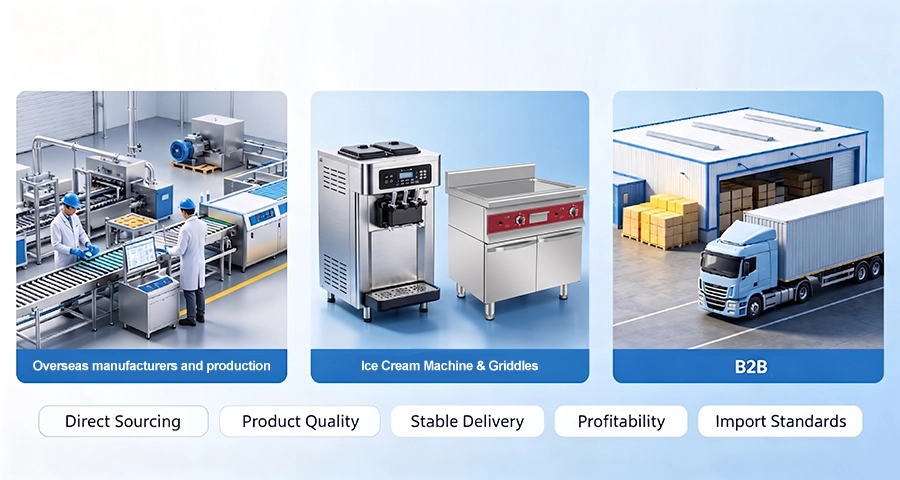
Many B2B buyers find it hard to balance cost and quality when buying from overseas. Over my years running a manufacturing business, I have helped many distributors navigate these exact challenges, and here is my guide to making your next import cycle seamless.
How to Meet Summer Demand with Smart Supply Chain & Stock Readiness?
Are you worried that shipping delays will make you miss out on peak summer sales? Buying kitchen equipment too late or shipping half-empty containers will quickly drain your profits and leave your customers empty-handed.
Plan your inventory early and bundle different equipment types together in your orders. Combining refrigeration units with heavy-duty griddles into single shipping containers maximizes your container space, lowers your freight costs, and ensures you have enough stock before the hot season starts.
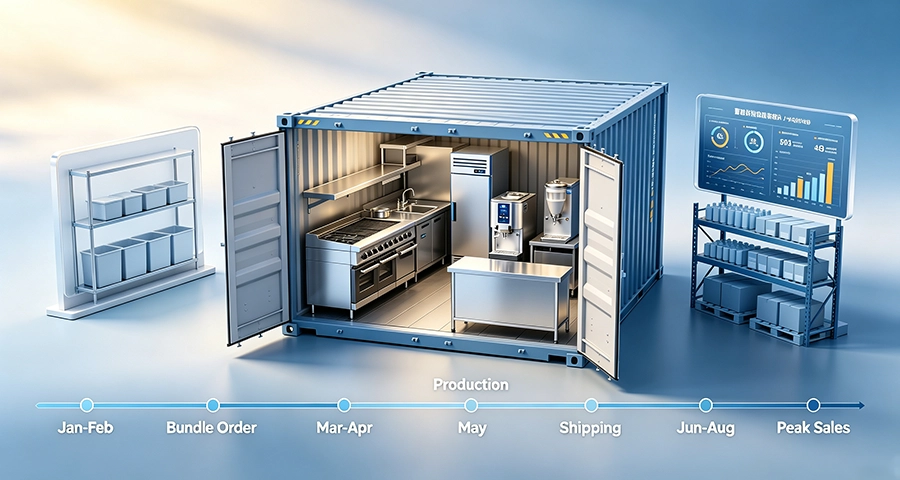
I always see buyers face stock shortages because they order too close to the hot season. In my experience, summer planning must start in the winter months. If you wait until April to place orders for soft serve or slush machines, production lines are already full. I manage this by encouraging a factory-direct bundled sourcing strategy. When you combine heavy items like griddles with bulky items like refrigeration units, you fill the shipping container completely. This stops items from shifting during transport and saves a lot of money on sea freight.
Summer Sourcing Timeline & Strategy
| Timeline | Action Step | Key Focus | Benefits |
|---|---|---|---|
| Jan – Feb | Place bundled orders | Combine griddles & refrigeration | Lower freight costs per unit |
| Mar – Apr | Factory production | Quality control & testing | Zero defects before shipping |
| May | Shipping & customs | Pre-assemble documents | No delays at the port |
| Jun – Aug | Peak sales season | Local distribution | Maximize profit margins |
This structured timeline ensures you never run out of stock when demand peaks.
What Are the High ROI Selling Points of Continuous Discharge Machines?
Are your clients complaining about slow beverage machines that cannot keep up with busy afternoon crowds? Slow dispensing speeds lead to long lines, lost sales, and very unhappy customers.
Multi-tank continuous discharge slush and frozen beverage machines solve this problem by serving drinks constantly. High-traffic operators usually recover their initial investment within two to four months because these machines have high output and great profit margins.
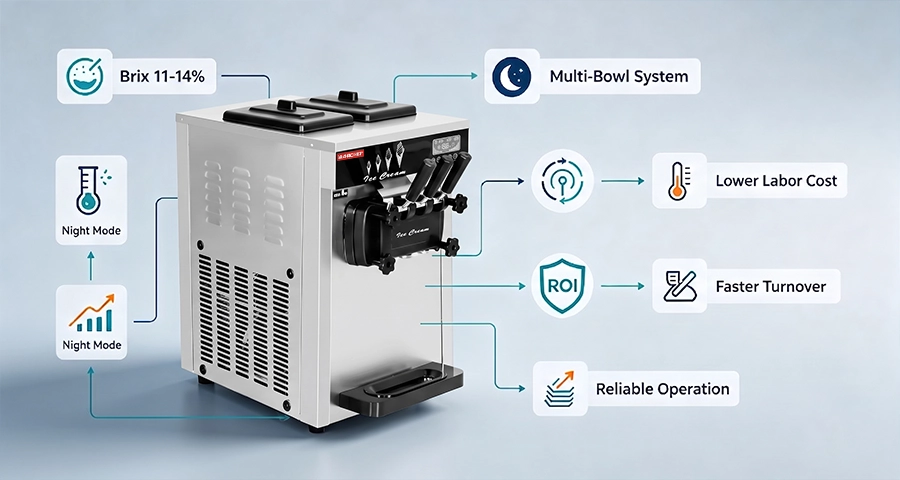
When I analyze the return on investment for beverage equipment, continuous discharge machines always stand out. These machines are perfect for busy spots. To help users protect their investment, I always emphasize correct operation. Keeping the sugar concentration between 11% and 14% Brix is vital. If the sugar level is too low, the water freezes into a solid block of ice. This ice block strains the motor and causes mechanical failure. Modern machines also feature a standby or night mode. This mode keeps the liquid mix chilled overnight without using too much electricity. When morning comes, the machine freezes the mix fast. This feature saves energy and helps businesses start selling immediately.
Key Performance Metrics for Frozen Beverage Machines
| Feature | Technical Detail | Business Benefit |
|---|---|---|
| Sugar Level | 11% to 14% Brix | Prevents ice blocks & protects motor |
| Standby Mode | Keeps mix chilled overnight | Reduces morning prep time & saves power |
| Multi-Tank | Separate controls for each bowl | Allows different flavors & easy cleaning |
How Can You Expand Your Portfolio with Gas & Electric Griddles?
Are you unsure whether to offer your customers gas or electric griddles? Choosing the wrong type can limit your target market and leave you with unsold inventory in your warehouse.
Offer both gas and electric griddles to meet different customer needs. Commercial gas griddles have 20% to 40% lower upfront costs than electric ones, while electric griddles offer precise temperature control that is perfect for delicate foods.
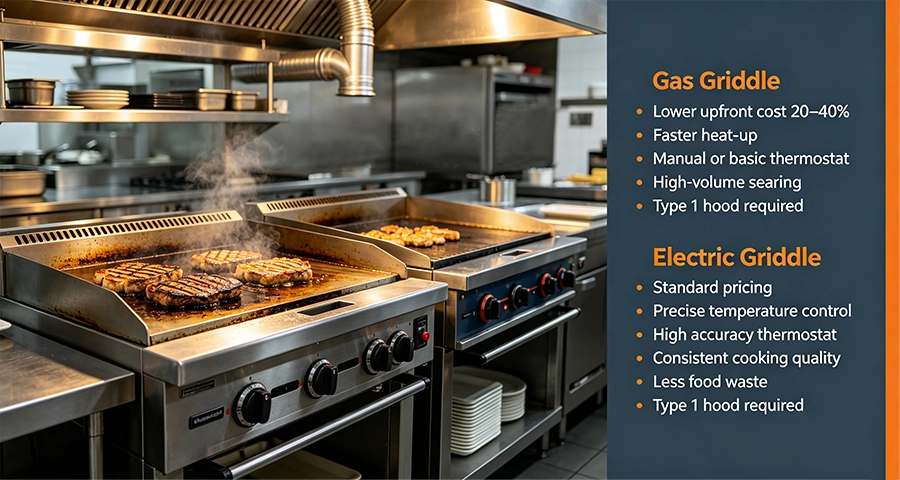
I manufacture both types because I know different kitchens have different rules. Gas griddles heat up fast and are cheap to buy. However, electric griddles with thermostatic controls are amazing at maintaining exact temperatures. When a chef drops frozen meat onto a hot griddle, the temperature drops fast. A manual valve takes too long to adjust, which burns or undercooks the food. Thermostatic controls react instantly. This feature reduces food waste and keeps food quality high. You must also remind your buyers about ventilation rules. Both gas and electric griddles require Type 1 ventilation hoods with proper airflow. This is a standard safety rule in almost every commercial kitchen.
Gas vs. Electric Griddle Comparison
| Feature | Commercial Gas Griddles | Commercial Electric Griddles |
|---|---|---|
| Upfront Cost | 20% to 40% lower | Standard pricing |
| Temperature Control | Manual or basic thermostat | Highly precise thermostatic control |
| Ventilation Needs | Requires Type 1 Hood | Requires Type 1 Hood |
| Best For | High-volume, quick-searing | Consistent, precise temperature cooking |
How to Ensure Seamless Customs Clearance with CE & ETL Compliance?
Have you ever had a shipment stuck at customs because of missing or incorrect safety certificates? Customs delays cost you extra storage fees and can cause you to lose your clients to other distributors.
Avoid customs delays by sourcing kitchen equipment that carries strict CE and ETL certifications. Global customs agents and local inspectors accept the ETL Listed mark as the exact safety equivalent to UL standards for electric and gas kitchen hardware.
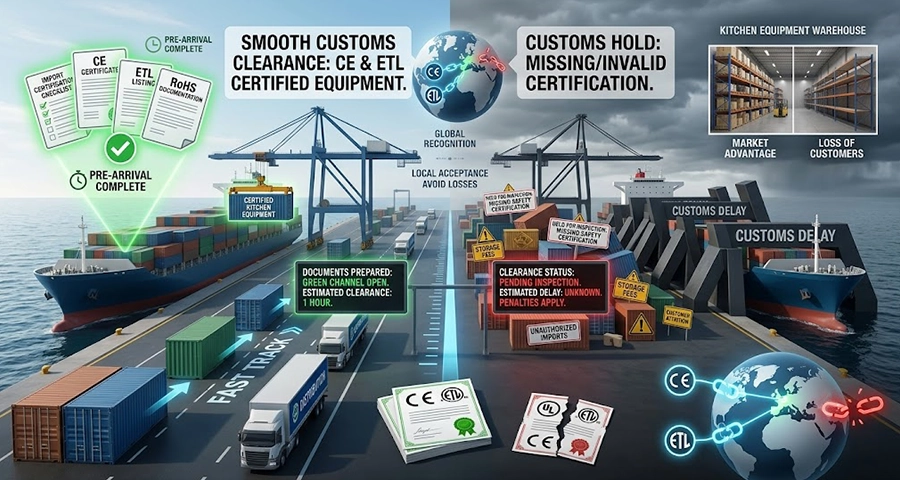
I have seen many importers face huge losses because they tried to import uncertified equipment. In Europe and North America, safety rules are very strict. The ETL mark is fully equivalent to the UL mark. This means inspectors will accept it without any issues. To prevent any problems during the busy summer customs rush, I always prepare the paperwork early. We compile full diagnostic and certification packages for our buyers. When your paperwork is ready before the ship arrives at the port, you can clear customs quickly and get your products to market without any extra fees.
Essential Import Certification Checklist
| Certification | Region | Application |
|---|---|---|
| CE Mark | Europe | Mandatory safety standard for electronics |
| ETL Listed | North America | Equivalent to UL standards for gas & electric |
| RoHS | Europe | Restricts hazardous substances in components |
How Can You Lower After-Sales Costs with Reliable Spare Parts?
Are high maintenance costs and slow spare part deliveries eating into your profit margins? If a customer’s machine breaks down and you do not have the right parts, you will lose their trust forever.
Lower your long-term maintenance costs by sourcing equipment made with standard, non-proprietary internal parts. Using common valves and compressors allows you to find replacement parts locally and fix issues quickly.
After-sales service can make or break a B2B business. If you buy equipment that uses rare, brand-specific parts, you will have to wait weeks for shipping when something breaks. That is why I prefer designing equipment with standard components. If a compressor or a valve needs replacement, local technicians can easily find the part in the local market. This simple design choice saves a lot of money on emergency shipping. It also keeps the end-users happy because their machines are back up and running in no time, which protects the reputation of the distributor.
Benefits of Non-Proprietary Components
- Local Availability: No need to wait for overseas shipping for minor repairs.
- Lower Costs: Standard parts are much cheaper than brand-specific ones.
- Faster Repairs: Local technicians already know how to work with these standard parts.
Conclusion
Smart sourcing is about finding high-quality, certified equipment with standard parts to keep your supply chain reliable, your costs low, and your B2B customers completely satisfied.