
Long ticket times destroy peak-hour margins. When fryers lose heat, kitchens stall, tickets pile up, and customers walk away. Substandard recovery rates directly undermine kitchen throughput and customer retention.
A fast fryer heat recovery rate ensures consistent oil temperature during cold-food drops, maintaining standardized batch cook times and preventing oil-soaked, soggy food. High recovery rates protect peak hourly ticket output and optimize oil life.
I have walked many busy commercial kitchens during Friday rush hours. The difference between smooth service and chaos comes down to how fast your fry vats bounce back to target temperatures.
Why Does Heat Recovery Time Dictate Peak-Hour Output?
Frozen food drops oil temperature instantly. Sluggish fryers stretch cooking cycles, creating kitchen bottlenecks and delaying orders. Slow equipment restricts your entire line during your most profitable operational hours.
Heat recovery time dictates output by establishing the minimum cycle time between cold product drops. Rapid thermal rebound eliminates extended cooking delays, allowing commercial kitchens to hit their maximum theoretical basket cycles per hour.
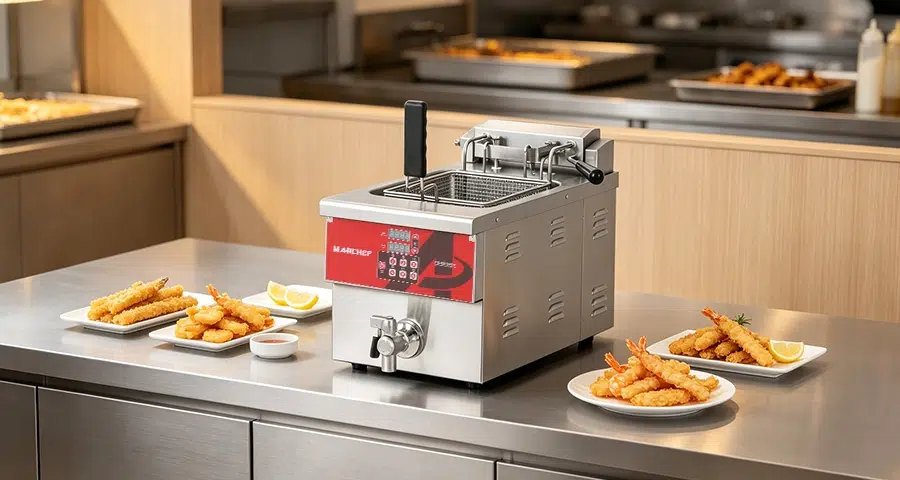
When you drop a frozen basket of fries into hot oil, the temperature drops fast. If the fryer cannot replace that heat immediately, the food boils in oil instead of frying. I tested this in our testing kitchen with different burner setups. A standard batch should take three minutes. On a slow-recovery unit, that same batch takes five minutes.
That two-minute delay compounds across fifty orders. Your kitchen falls behind, drive-thru lines back up, and order accuracy drops. Standardized production schedules depend entirely on consistent thermal recovery.
Thermal Recovery Impact on Hourly Yield
| Recovery Speed | Temp Drop Upon Drop | Time to Rebound | Batches Per Hour | Hourly Yield (kg) |
|---|---|---|---|---|
| Fast Recovery | 15°C to 20°C | 45-60 seconds | 18-20 batches | ~45 kg |
| Medium Recovery | 25°C to 35°C | 90-120 seconds | 12-14 batches | ~30 kg |
| Slow Recovery | 40°C+ | 150+ seconds | 8-10 batches | ~20 kg |
High-recovery units protect the cooking window. You get predictable ticket times and maintain constant kitchen flow throughout peak rushes.
What Are the Hidden Operational Costs of Slow Thermal Recovery?
High oil bills and customer complaints ruin profit margins. Kitchens blame oil quality, but sluggish thermal response is often the real problem. Hidden costs erode your bottom line every single day.
Slow recovery forces food to sit in suboptimal oil temperatures, increasing oil absorption by up to 20%. This ruins crispiness, accelerates oil degradation through oxidation and hydrolysis, and increases utility and HVAC loads.
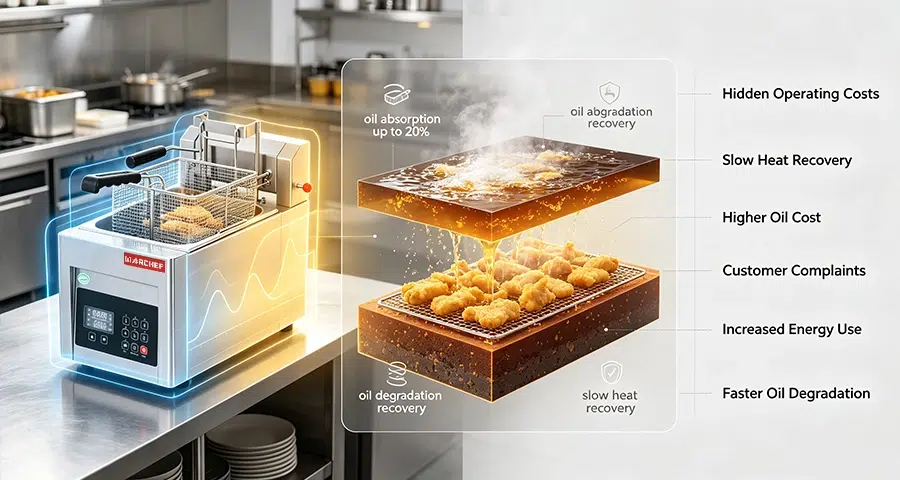
Oil is one of the highest recurring consumable costs in fast food operations. When oil temperature stays below 175°C for too long, food acts like a sponge. It absorbs excess oil. This creates greasy food and depletes the vat faster, forcing staff to top up oil more frequently.
Slow rebound also ruins oil chemistry. Extended exposure to moisture at low temperatures causes rapid hydrolysis and builds free fatty acids. At the same time, inefficient heat transfer vents waste heat into the kitchen. Your air conditioning must work harder to cool the space, driving up electricity bills.
Hidden Operational Costs Breakdown
| Cost Factor | Slow Recovery Impact | High Recovery Impact | Long-Term Operational Effect |
|---|---|---|---|
| Oil Consumption | High (Heavy absorption) | Low (Instant surface seal) | Up to 20% lower annual oil spend |
| Oil Breakdown | Fast FFA accumulation | Stable chemical profile | Extended days between oil discards |
| HVAC Load | High radiant ambient heat | Heat directed into oil vat | Reduced kitchen cooling energy bills |
| Component Stress | Constant max-fire cycles | Modulated thermal bursts | Lower element and burner fatigue |
Fast recovery seals the product exterior instantly. You keep oil in the vat, preserve product texture, and lower utility overhead.
Which Key Engineering Features Drive Fast Heat Recovery?
Outdated heating elements cannot transfer thermal energy fast enough. Weak controls react too late to cold drops, leaving food sitting in cool oil. Engineering design separates elite fryers from average units.
Fast heat recovery relies on high-surface-area heat exchangers, infrared burner matrices, low-mass immersion thermistors, and solid-state controls. These components detect temperature drops in milliseconds and transfer thermal energy directly into the oil.
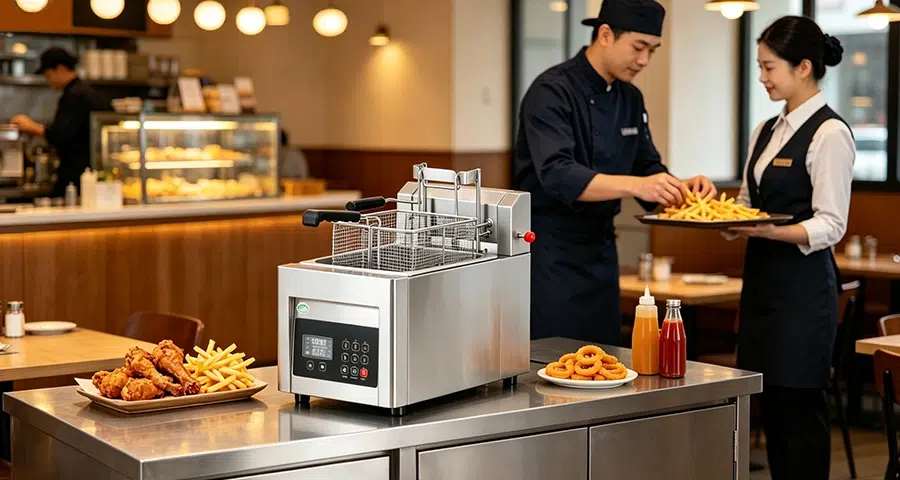
The engineering inside the vat determines performance. Traditional mechanical snap-action thermostats take up to fifteen seconds to register a temperature drop. By that time, the oil is already cold. Modern solid-state controls use low-mass thermistors to detect temperature shifts instantly, firing the elements within one second.
Heat transfer mechanics also matter. Flat electric elements provide greater surface contact with the oil than round tubular elements. In gas models, internal baffle systems and infrared matrices force heat into the oil rather than letting it escape up the flue.
Engineering Feature Comparison
| Component | Standard Design | Advanced High-Recovery Design | Performance Advantage |
|---|---|---|---|
| Temperature Sensor | Mechanical bulb thermostat | Low-mass immersion thermistor | Instant drop detection under 1 second |
| Electric Elements | Round tubular steel | Flat high-surface-area elements | 30% more direct oil contact area |
| Gas Heating | Atmospheric open burners | Infrared matrix with internal baffles | Direct radiant heat with less flue loss |
| Control System | Analog dial control | Solid-state digital controller | Precise predictive heating algorithms |
Advanced heating systems deliver power precisely when needed, keeping vat temperatures stable under continuous load.
How Should Dealers and Chains Source High-Recovery Units?
Buying strictly on price leads to underspecified fryers that fail during peak demand. Multi-unit operations need reliable performance data before signing bulk equipment contracts. Sourcing errors cause operational headaches across every location.
Dealers and chains should evaluate fryers using ASTM F1361 (electric) and ASTM F2144 (gas) standardized test standards. Buyers must verify power-to-volume density ratios and require certified third-party recovery data before placing volume purchase orders.
When sourcing fryers for commercial operations, look past marketing brochures and examine raw technical specifications. You must calculate the power-to-volume ratio. An electric fryer with 18 kW of power for a 20-liter vat delivers a healthy ratio of 0.9 kW per liter. If that same 18 kW powers a 28-liter vat, the ratio drops to 0.64 kW per liter, leading to sluggish recovery under heavy cold-food drops.
Insist on ASTM standardized test reports from manufacturers. ASTM F1361 and ASTM F2144 define clear benchmarks for heavy-load recovery time, energy efficiency, and production capacity per hour. These numbers give you an objective baseline to compare factory claims.
Sourcing Evaluation Checklist
| Evaluation Metric | Target Benchmark | Sourcing Verification Method |
|---|---|---|
| Power Density Ratio | $\ge 0.85\text{ kW per Liter}$ | Check rated input against oil capacity |
| Standard Testing | ASTM F1361 / ASTM F2144 | Request certified third-party lab test reports |
| Vat Geometry | Deep cold zone with steep slopes | Inspect tank drawings for sediment control |
| Component Sourcing | Commercial-grade valves & sensors | Review factory Bill of Materials (BOM) |
Specifying equipment by power density and verified test standards protects your kitchens from costly thermal bottlenecks.
Conclusion
Fryer heat recovery rate dictates ticket speed, food quality, and oil life. Sourcing equipment with high power density and advanced controls protects your peak-hour profitability and daily operational consistency.