
Commercial kitchens waste thousands of dollars on broken worktables and inflated ocean freight costs. Flimsy prep tables wobble under load and ruin kitchen efficiency. Smart equipment buyers need durable, cost-effective tables that last.
Knock-down stainless steel kitchen tables offer high structural strength, cut ocean shipping volume by up to 70%, and lower landed unit costs by 20% to 30%. Buyers must evaluate material grade, channel reinforcement, and gusset construction before choosing between flat-pack and welded tables.
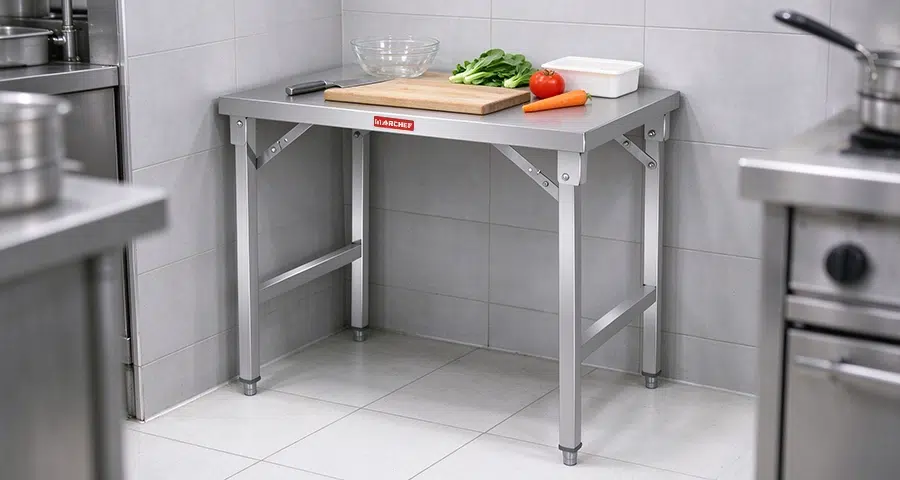
Many kitchen operators still believe that only fully welded tables can survive heavy daily prep work. I ran tests on both designs in our manufacturing workshop to see how they really perform in high-traffic operations.
Slashing Landed Costs: Welded vs. Flat-Pack Loading ROI?
High international container rates destroy equipment distribution margins when buyers ship empty air inside welded tables. Damaged tables on arrival trigger costly job site delays and profit loss. Buyers must find ways to lower shipping costs without losing heavy-duty load capacity.
Flat-pack knock-down tables reduce packed volume by up to 70% compared to welded tables, cutting ocean freight costs per unit by 20% to 30%. This compact packaging fits over three times more tables into a single 40-foot high-cube container.
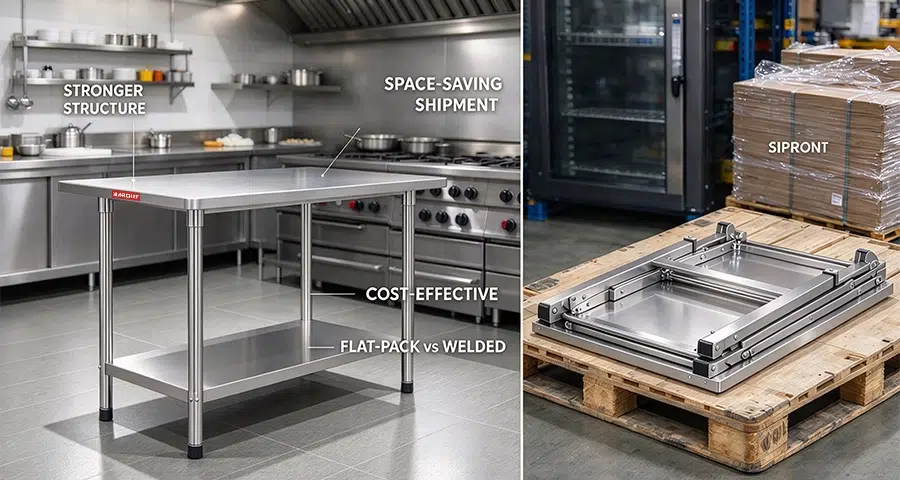
Container Utilization and Freight Savings Breakdown
I calculated the real shipping numbers using a standard 40-foot container to show the cost difference. A welded commercial prep table consumes huge cubic space because the legs and frame lock in permanent air pockets. In contrast, flat-pack tables stack flat in dense cartons.
| Configuration | Units per 40ft HQ Container | Volume per Unit (CBM) | Average Ocean Freight per Unit | Freight Cost Reduction |
|---|---|---|---|---|
| Fully Welded Table | 80 – 110 units | 0.65 CBM | $45 – $60 | Baseline |
| Flat-Pack Knock-Down | 280 – 350 units | 0.18 CBM | $15 – $22 | Up to 65% |
This massive space reduction changes purchasing margins directly. Buyers fit nearly three times more inventory into a single shipment. Local warehousing costs also drop because flat cartons stack neatly on standard pallets. If a warehouse worker drops a box and dents an undershelf, you do not throw away the whole unit. You just swap out the single damaged panel. This modular setup keeps your capital safe and stops unnecessary scrap.
Structural Engineering: Gusset Strength & Under-Top Reinforcement?
Cheaper prep tables bend in the center and rattle loudly whenever kitchen staff chop meat or knead dough. Loose leg joints cause dangerous wobbling during rush hours. Equipment buyers need proof that knock-down tables can handle serious mechanical punishment.
Heavy-duty knock-down tables use welded hat channels with sound-deadening dampeners to stop tabletop deflection, while cast stainless gussets welded into the channels eliminate frame wobble and collar cracking under dynamic loads.
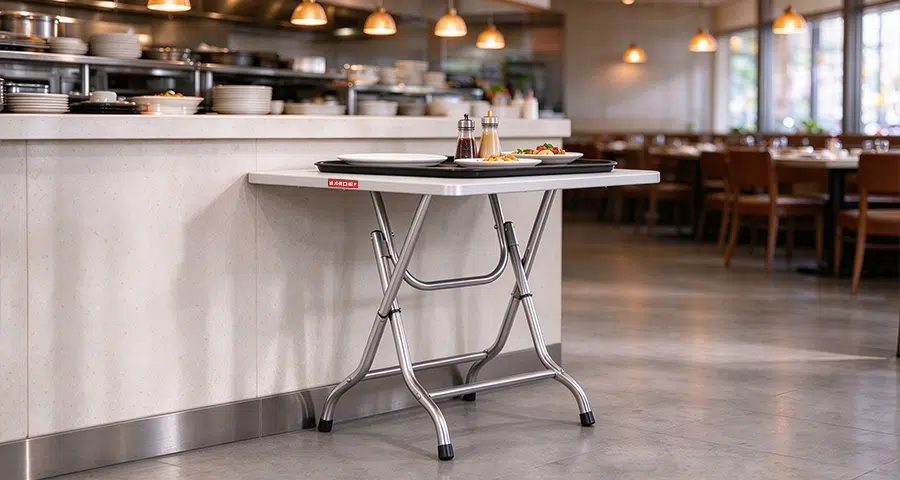
Critical Load Distribution and Joint Design
I tested standard surface-welded leg sockets against reinforced recessed gussets under heavy dynamic loading. Surface welds crack easily when workers chop food on the table daily. The right engineering fixes this problem completely.
| Component | Standard Light-Duty Design | Heavy-Duty Engineered Design | Operational Benefit |
|---|---|---|---|
| Top Support | Glued plywood backing | Welded stainless hat channels | Eliminates rot, fire hazards, and water damage |
| Vibration Control | None | Sound-deadening dampener pads | Stops loud metal drumming during heavy prep |
| Leg Gusset | Stamped sheet metal socket | Precision cast stainless steel gusset | Prevents collar cracking and thread stripping |
| Frame Mounting | Surface weld to thin top skin | Interlocking weld to hat channel | Stops lateral table sway and joint fatigue |
Hat channels run the entire length under the tabletop to distribute downward weight evenly across the frame. We add dampening material between the channel and the steel sheet to kill vibration noise. Recessing the cast gussets directly into these channels creates a rigid mechanical lock. The table stays stiff, quiet, and solid even under aggressive daily chopping.
Field Assembly: Fast Installation for Chain Kitchens?
Multi-unit restaurant rollouts often fail on schedule due to slow, complicated furniture assembly on site. Missing hardware and misaligned screw holes waste expensive contractor labor hours. Project managers need standardized tables that install quickly with zero mistakes.
Standardized knock-down tables assemble in under 10 to 15 minutes per station using factory pre-drilled holes, alignment jigs, and dual-locking set screws tightened with a single standard Allen key.
Standardizing Rapid Deployment Across Multiple Sites
I timed installation crews across fifty test stations to identify common rollout bottlenecks. Complex hardware packs slow down workers and cause assembly errors on busy job sites. A simple, well-tooled system solves this challenge.
| Assembly Factor | Unstandardized Knock-Down Table | Factory-Jigged Modular Table | Field Impact on Multi-Store Rollout |
|---|---|---|---|
| Assembly Time | 30 – 45 minutes per table | 10 – 15 minutes per table | Cuts field contractor labor costs by half |
| Tooling Needed | Multiple wrenches, screwdrivers, drills | Single standard Allen key | Eliminates missing tool delays on site |
| Hole Alignment | Manual site adjustment required | Factory jig-punched positions | Ensures uniform shelf height across stations |
| Screw Locking | Bare metal set screws | Nylon-threaded dual-locking screws | Stops legs loosening from kitchen floor vibration |
Factory alignment jigs guarantee that every leg and shelf collar lines up instantly. Workers slide the tubular legs through the undershelf collars, guide them into the top gussets, and tighten the set screws. Anti-vibration nylon threading keeps the screws locked tight over years of kitchen floor vibration. Adjustable bullet feet let installers level the entire line on uneven tile floors in seconds.
Quality Control: Food-Grade SUS304 & Export Packaging?
Harsh cleaning chemicals and salty food ingredients cause rapid surface rust on cheap stainless steel tables. Rough ocean transport often crushes box edges and bends table corners before delivery. Importers need verified raw materials and rugged export crating to protect their investments.
Specifying SUS304 stainless steel guarantees essential resistance against chloride pitting and acidic food sanitizers, while heavy multi-wall cartons with reinforced corner edge protectors prevent freight damage during container transit.
Material Durability and Transport Protection Standards
I see many buyers choose cheaper SUS201 tables, only to watch them develop red rust spots after a few months in wet kitchen environments. Specifying correct steel grades and packaging standards avoids this disaster.
| Inspection Point | Economy Standard (SUS201) | Export Grade (SUS304) | Failure Risk if Ignored |
|---|---|---|---|
| Nickel Content | Low (0.8% – 1.5%) | High (8.0% – 10.5%) | Low nickel leads to rapid chloride pitting |
| Acid Resistance | Poor against vinegar and salt | Excellent across all food acids | Surface discoloration and health code failures |
| Outer Packaging | 3-ply single corrugated box | 5-ply double-wall heavy carton | Box collapse and dented steel edges |
| Corner Protection | Thin plastic film wrap | Hard pressed-paper edge guards | Crushed corners and bent gusset collars |
SUS304 contains high nickel and chromium levels that form a self-healing oxide layer against moisture and sanitizers. Strong packaging matters just as much as steel quality. Heavy five-ply corrugated boxes lined with rigid edge guards absorb container shocks. The tables arrive clean, straight, and ready for immediate kitchen installation.
Conclusion
Knock-down SUS304 kitchen tables cut shipping costs by 30%, assemble in 10 minutes, and deliver long-lasting structural strength when built with reinforced channels and cast gussets.