
Rising oil prices hurt commercial kitchen margins every single day. Burned food debris ruins expensive frying oil fast, which forces operators to dump batches prematurely and drains restaurant profits unnecessarily.
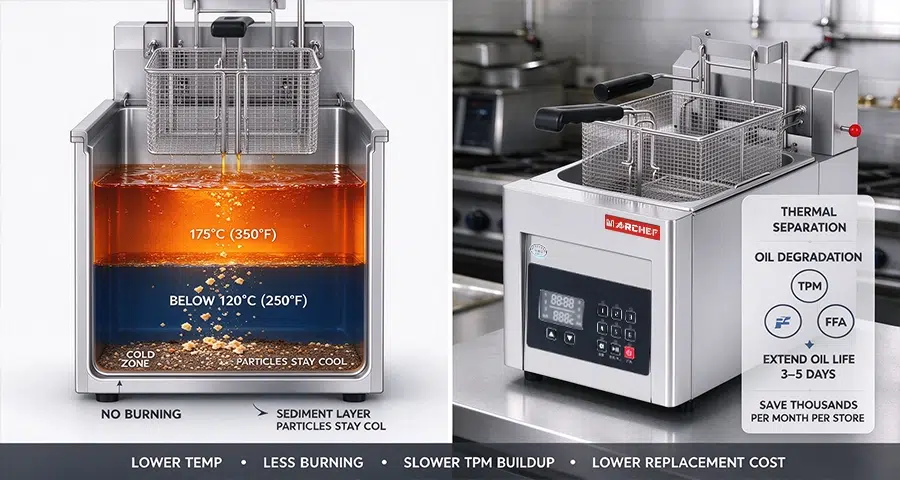
A deep fryer cold zone traps falling food particles in oil cooled below 120°C (250°F). This temperature separation stops debris from scorching, slows down oil degradation, extends oil life by several days, and directly cuts kitchen operating costs.
Most kitchen buyers overlook frypot internal structure during procurement. I spent years manufacturing commercial frypots in our factory, and I watched many buyers purchase units that degraded oil within forty-eight hours because the lower tank geometry did not fit their cooking reality.
Why Does Cold Zone Depth Dictate Restaurant Chain OPEX?
High fryer oil replacement costs destroy annual store profitability. Neglecting tank sedimentation rates accelerates lipid breakdown, which turns clean oil dark, spoils food flavor, and spikes store operational expenditures.
Cold zone depth dictates oil lifespan because a deep reservoir keeps sediment below the 120°C scorching threshold. This thermal separation prevents particle carbonization, delays polar material accumulation, and lowers oil replacement costs.
The Chemistry of Thermal Separation and Oil Degradation
I tested fryer tanks on our factory line for many weeks. I found that sediment scorches instantly when it touches direct heat. Scorched flour acts as a chemical catalyst. It speeds up the formation of total polar compounds (TPM). It increases free fatty acids (FFA). Once TPM values cross twenty-four percent, kitchen staff must dump the entire oil vat immediately.
A deep sediment reservoir creates a physical drop zone beneath the active heat source. The oil at the top cooks chicken at 175°C (350°F). The oil at the bottom stays under 120°C (250°F). Settled particles do not burn at this lower temperature. They stop releasing bitter tastes. They stop spreading carbon particles into the cooking area. When a kitchen keeps crumbs away from high heat, frying oil lasts three to five days longer. That difference saves a busy multi-unit chain thousands of dollars every month per store.
| Performance Factor | Shallow Sump Tank | Deep Cold Zone Tank |
|---|---|---|
| Sump Temperature | Exceeds 150°C (302°F) | Stays below 120°C (250°F) |
| Particle Condition | Scorched and carbonized | Soft and unburned |
| TPM Growth Rate | Rapid (3 to 4 days to discard) | Slow (7 to 9 days to discard) |
| Oil Drag-out Waste | High due to floating crumb sludge | Low due to clean sediment pooling |
| Annual Oil Turnover | 90 to 110 vat fills per year | 45 to 60 vat fills per year |
How Do Tube-Fired and Open-Pot Designs Handle Food Sediment?
Selecting the wrong frypot geometry causes constant kitchen operational failures. Operators battle dirty frying oil, slow recovery rates, and grueling daily cleaning routines when tank mechanics fail to match kitchen breading output.
Tube-fired fryers utilize internal burner pipes to create an expansive, low-temperature sediment zone for heavy breading. Open-pot fryers heat exterior walls to provide an unobstructed, easy-to-clean tank ideal for low-sediment items like frozen fries.
Internal Heating Tubes Versus External Transfer Systems
I regularly walk workshop floors where workers weld fryer vats. The engineering contrast between these two systems changes how kitchens manage dirt. Tube-fired units run gas tubes straight through the lower third of the oil vat. The burner tubes push heat forward into the cooking zone. This orientation leaves a large, undisturbed well of cooler oil below the pipes. Breading from raw flour and battered fish falls between the tubes. It rests safely on the tank bottom.
Open-pot fryers keep heating elements or gas burners on the outside of the metal tank. The inside vat remains smooth and open. This configuration offers very little room below the heat zone for settling crumbs. It leaves no safe harbor for large masses of flour. Loose breading remains close to the primary heat source. It burns quickly if kitchen staff do not skim the vat continuously. However, open-pot tanks allow kitchen staff to wipe down walls in two minutes, whereas tube-fired units demand specialized cleaning rods to scrub underneath tight burner pipes.
| Operational Feature | Tube-Fired Frypot | Open-Pot Frypot |
|---|---|---|
| Primary Heat Location | Submerged internal tubes | External tank walls or strip burners |
| Sediment Basin Capacity | Large (30% to 35% of oil volume) | Small (10% to 15% of oil volume) |
| Ideal Menu Items | Hand-breaded chicken, wet fish | Par-fried fries, pre-cooked finger food |
| Cleaning Complexity | High (requires crumb scrapers) | Low (flat walls wipe down fast) |
| Daily Filtration Need | Moderate (tolerant of crumb volume) | High (requires rapid sediment removal) |
How Should Buyers Match Fryer Tank Geometry to Menu Types?
Kitchens that cook fresh-battered foods in shallow fryers suffer severe economic penalties. Sediment absorbs usable oil, scorches quickly, and degrades food texture, which forces owners to discard expensive cooking oil prematurely.
Match fryer tank geometry by checking the sediment production rate of your food. Choose tube-fired tanks with deep cold zones for raw-dredged proteins, and choose open-pot tanks for frozen appetizers to achieve optimal oil efficiency.
Breading Density and Volumetric Oil Requirements
I once visited a high-volume fried chicken store that bought modern open-pot fryers. Their managers complained about dark, smelly oil after just two shifts. The issue was not their oil brand. The problem was their menu. They hand-dipped raw chicken cutlets in seasoned flour all day long. Loose flour drifted off the meat immediately. Because their fryers lacked deep lower reservoirs, the loose flour rested right against the heated tank walls. The debris turned black within hours.
Kitchen menus fall into clear sediment categories. Scratch-made breading sheds high volumes of wet starches and dry powders. These heavy particles fall quickly through the oil. They need a deep reservoir so they do not sit in hot cooking zones. Pre-cut frozen potato fries shed almost no crumbs. They only release tiny potato fragments and pure water steam. You can fry frozen potatoes in an open vat with a tiny sediment shelf without risking premature oil failure. Sourcing decisions must start with the food ingredient list, not standard equipment catalog sheets.
| Menu Category | Typical Food Items | Sediment Rate | Recommended Tank Style |
|---|---|---|---|
| Heavy Dredge | Southern fried chicken, onion rings | High (15g to 25g per drop) | Tube-fired with extended cold well |
| Wet Batter | Beer-battered cod, tempura shrimp | Medium-High (loose floating bits) | Deep sump with surface skimmer |
| Light Breading | Breaded pork cutlets, mozzarella sticks | Medium (5g to 10g per drop) | Standard tube or assisted open-pot |
| Low Sediment | Frozen French fries, potato wedges | Low (under 2g per drop) | Flat open-pot or electric flat-bottom |
What Specs Should You Verify on a Commercial Fryer Checklist?
Ordering commercial fryers without verifying cold zone capacity causes long-term operating losses. Misjudged tank volumes, missing filtration pumps, and poor drain engineering increase downtime and drain commercial kitchen capital.
Verify five critical fryer specifications: sediment zone depth, cold zone oil volume ratio, built-in filtration pump speed, vat drain valve diameter, and total polar material degradation rates before issuing any equipment purchase order.
Key Engineering Points for Multi-Unit Purchasing
I always tell buyers to look beyond nameplate heating power. High British Thermal Units (BTUs) or kilowatts mean nothing if the tank geometry destroys your oil budget. You must examine the mechanical blueprints of the vat. Check the space between the bottom of the heat exchangers and the floor of the tank. That measurement defines your usable debris safety buffer. If that space measures less than three inches, you cannot run hand-breaded food through that fryer without high filtration labor.
Next, examine the drain valve hardware. Sediment-heavy vats need a minimum 1.25-inch full-port drain valve. Small drain holes clog with congealed flour and grease. This forces workers to poke rods into hot vats, which presents severe burn hazards. Finally, evaluate automated filtration systems. A low-oil-volume (LOV) open-pot fryer can offset a shallow cold zone, but only if it includes a motorized filter pump that cycles oil every thirty minutes. If the unit lacks an automated pump, you need a deep mechanical cold zone to protect your oil.
| Technical Specification | Target Requirement | Operational Purpose |
|---|---|---|
| Cold Zone Height | Minimum 75mm (3.0 inches) | Prevents hot oil thermal convection from stirring debris |
| Sump Volume Share | 20% to 30% of total oil capacity | Holds peak-shift sediment without overflow into cooking area |
| Drain Valve Bore | 1.25-inch or 1.5-inch full port | Prevents sludge blockages during hot oil evacuation |
| Filtration Cycle Time | Under 4 minutes per vat cycle | Returns hot oil quickly without interrupting customer service |
| Vat Steel Grade | 304 stainless steel, minimum 1.5mm | Resists pitting corrosion caused by salt and food acids |
Conclusion
Cold zone depth and tank geometry determine commercial oil lifespan. Match your fryer tank design to food sediment levels to control total polar materials, extend oil life, and safeguard kitchen profitability.