
Are you struggling with long marinating times, uneven meat flavors, and high labor costs in your kitchen? Slow soaking wastes time and yields inconsistent food quality.
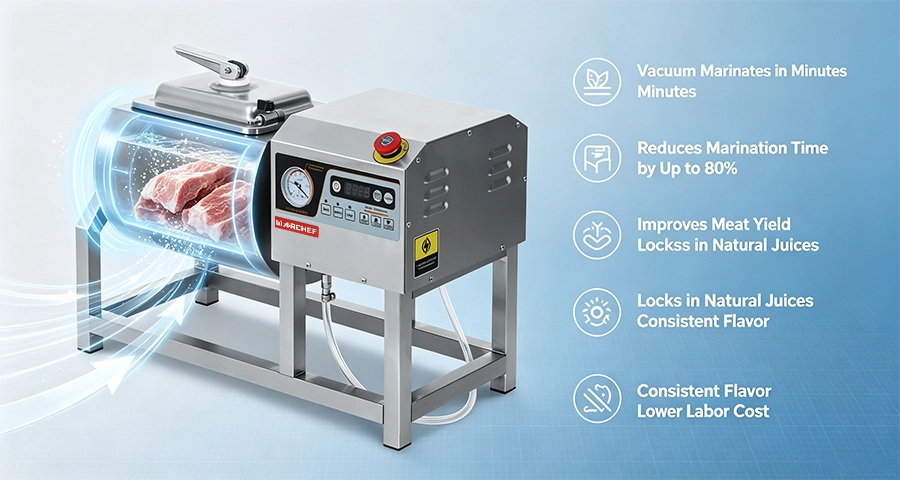
Commercial vacuum tumblers use vacuum pressure to expand meat fibers, pulling marinades deep into the core within minutes. This process increases product yield, reduces processing time by up to 80%, locks in natural juices, and eliminates flavor inconsistencies in central kitchen operations.
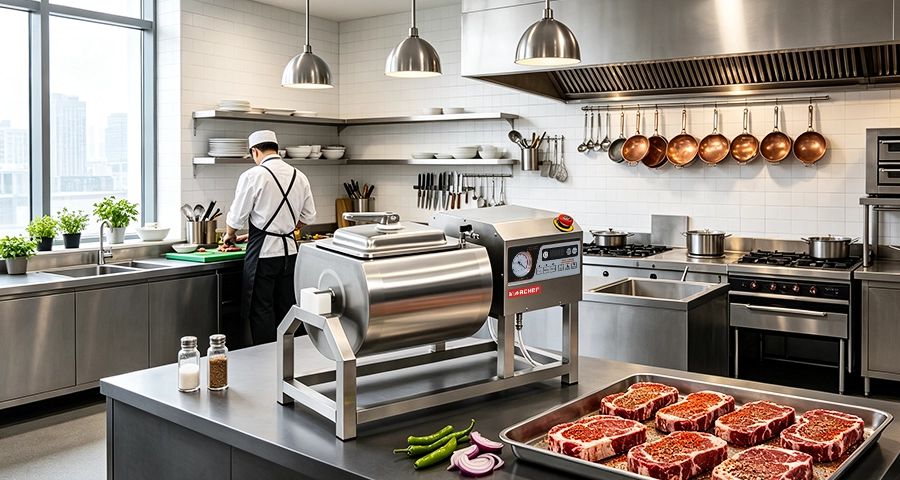
I have spent years building commercial kitchen equipment in our Guangzhou factory. I often see central kitchen managers waste money on slow marinating methods. Let me show you how vacuum tumbling transforms meat processing and increases your profit margins.
Why Are Commercial Vacuum Tumblers Essential for Modern Food Services?
Do your kitchen operations lose money because of slow marinade absorption and heavy cooking shrinkage? Waiting hours for seasonings to soak into large cuts creates massive bottlenecks.
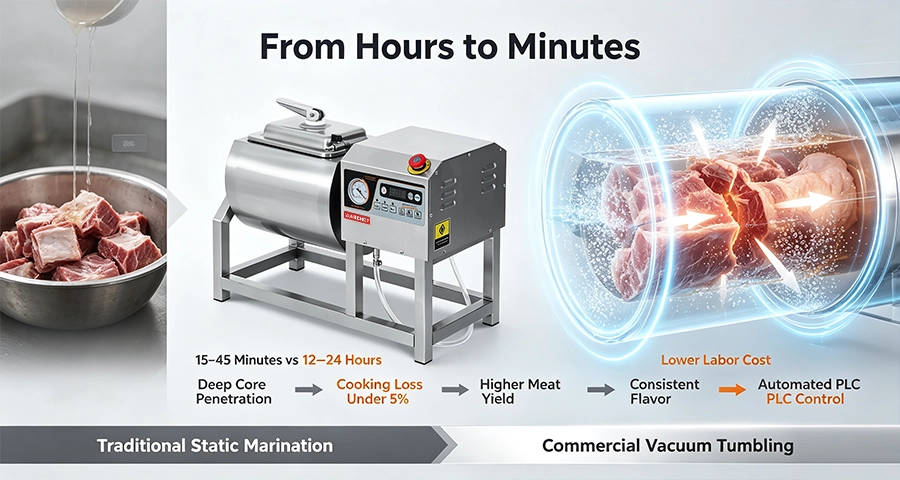
Vacuum tumblers are essential because they cut marinating times from hours to minutes while boosting meat weight and tenderness. They extract surface proteins to bind juices, which reduces cooking loss and significantly lowers daily labor expenses.
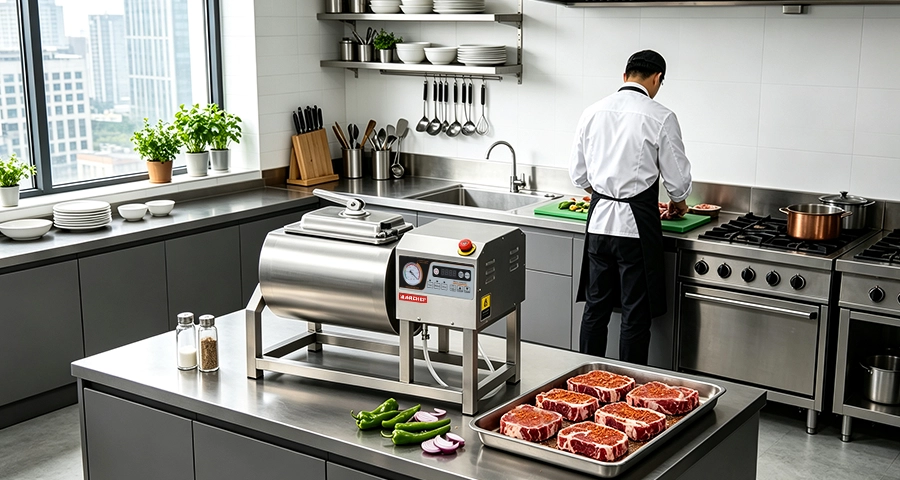
From Hours to Minutes: How Vacuum Tumbling Accelerates the Marinating Process
In my early years of manufacturing equipment at MARCHEF, I visited many food processing plants across Southeast Asia and Europe. A common problem was time. Traditional static soaking takes up to 24 hours for thick cuts of beef or pork. A commercial vacuum tumbler achieves better liquid penetration in just 20 to 30 minutes. The vacuum removes air pockets from the drum. This pressure difference forces the brine solution directly into the muscle cells.
Improving Muscle Yield and Flavor Consistency in Large-Scale Meat Processing
When you process hundreds of kilograms of meat daily, yield retention determines your profit. Mechanical tumbling extracts soluble myofibrillar proteins to the surface of the meat. These proteins form a natural gel coating. This protein matrix seals in moisture during cooking. Your cooked meat stays juicy, weighs more, and retains full flavor across every single batch.
Reducing Labor Costs and Food Waste in Central Kitchen Operations
Manual meat turning requires heavy labor and increases safety risks. An automated vacuum marinator handles thousands of pounds without manual intervention. You save on labor hours and reduce batch-to-batch human errors.
| Processing Parameter | Traditional Static Soaking | Commercial Vacuum Tumbling |
|---|---|---|
| Marinating Time | 12 to 24 Hours | 15 to 45 Minutes |
| Core Penetration | Shallow / Surface Level | Deep / Core Level |
| Cooking Yield Loss | 15% to 25% Loss | Less than 5% Loss |
| Labor Requirement | High (Manual Turning) | Low (Automated PLC) |
| Bacterial Growth Risk | High (Extended Exposure) | Very Low (Anaerobic Drum) |
How Does a Commercial Vacuum Marinator Work?
Do you know what actually happens inside a sealed tumbling drum under negative pressure? Many kitchen owners buy these machines without understanding how mechanical action and pressure changes manipulate meat structure.
A commercial vacuum marinator works by creating a negative pressure environment that expands muscle fibers and pulls out trapped air. The rotating drum repeatedly drops the meat, massaging the tissue and driving brine rapidly into the core.
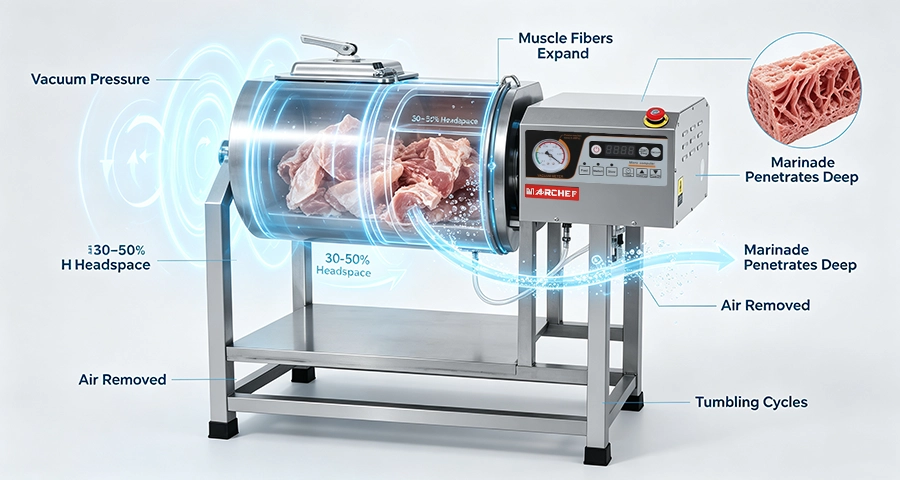
Vacuum Pressure vs. Traditional Soak: The Principle of Muscle Fiber Expansion
When the vacuum pump lowers the drum pressure, it evacuates oxygen from the chamber. This negative pressure causes tiny air spaces inside the meat tissue to expand. The liquid marinade naturally flows into these newly opened spaces. Because oxygen is removed, aerobic bacterial growth stops during processing. This keeps your raw meat safe and fresh.
Continuous vs. Intermittent Tumbling: Choosing the Right Cycle for Different Meats
Not all meat requires the same mechanical force. Delicate poultry or seafood needs gentle handling, while dense beef briskets need firm massaging. Modern vacuum tumblers alternate between continuous rotation and pulsating rest cycles. The pulsating action creates a continuous expansion and contraction effect inside the meat tissue.
| Meat Type | Recommended Vacuum Level | Rotation Speed | Tumbling Cycle |
|---|---|---|---|
| Poultry & Wings | -0.04 to -0.06 MPa | 4 to 6 RPM | Intermittent (5 min run / 5 min rest) |
| Pork Chops & Ribs | -0.06 to -0.07 MPa | 7 to 9 RPM | Continuous or Intermittent |
| Beef Brisket & Hams | -0.07 to -0.08 MPa | 8 to 12 RPM | Continuous with Pulse Vacuum |
| Fish Fillets | -0.02 to -0.04 MPa | 2 to 4 RPM | Gentle Intermittent |
Pairing pre-tumbling multi-needle brine injection with vacuum tumbling speeds up deep-core curing in dense cuts. In my experience, whole hams require injection before tumbling to achieve complete salt balance. Always remember to leave 30% to 50% headspace inside the drum. This space allows proper gravity drops while the drum rotates.
What Are Key Features to Look for When Choosing a Vacuum Tumbler?
Are you unsure which machine specifications match your daily production needs and hygiene standards? Buying the wrong size or build quality leads to early equipment failure and costly production downtime.
Look for heavy-duty SUS304 stainless steel construction, reliable vacuum pumps with adjustable controls, programmable PLC touchscreens, and proper drum capacities that leave at least 30% headspace for optimal mechanical tumbling action.
Heavy-Duty Stainless Steel Construction (SUS304) & Food Safety Compliance
I always tell my foreign buyer clients that material quality is non-negotiable. Food processing equipment must resist salt, spices, and liquid acids. We build our MARCHEF tumblers using food-grade SUS304 stainless steel. This material prevents rust, stops metal contamination, and satisfies strict European CE and food safety regulations.
Vacuum Pump Reliability and Adjustable Pressure Controls
The vacuum pump is the heart of your machine. You need a durable pump that maintains target pressure without drops. A pressure drop leads to uneven seasoning penetration and mushy meat texture. Integrated glycol cooling jackets on industrial drums keep batch temperatures below 4°C. This prevents friction heat from damaging delicate proteins.
Capacity Selection Guide: Matching Machine Size to Daily Meat Output
Choosing the right capacity keeps your central kitchen running smoothly. Never fill a drum to 100% capacity. A drum needs empty space so the meat can fall and massage itself against the drum walls.
| Drum Capacity | Maximum Meat Load | Target Business Scale | Key Recommended Features |
|---|---|---|---|
| 50 Liters | 25 to 30 kg | Small Restaurants / R&D Labs | Compact footprint, Manual Controls |
| 200 Liters | 100 to 120 kg | Medium Central Kitchens | Digital Timer, Variable Speed |
| 500 Liters | 250 to 300 kg | Large Food Processing Plants | PLC Touchscreen, Automatic Tilting |
| 1000+ Liters | 500 to 600 kg | Industrial Meat Factories | Automated CIP, Vacuum Loader |
User-Friendly PLC Touchscreens & Programmable Tumbling Recipes
Modern commercial tumblers use digital PLC touchscreens. You can store custom recipes for chicken wings, beef steaks, or pork ribs. Workers simply select a program and press start. This removes guess work and ensures identical quality on every shift.
How to Manage Maintenance, Food Hygiene, and Operational Safety?
Are you worried about food safety risks and unexpected machinery breakdowns in your daily operations? Improper cleaning and neglected pump maintenance destroy machine performance and cause costly contamination issues.
Manage safety and hygiene by implementing daily Clean-in-Place (CIP) sanitation, checking drum lid gaskets regularly, servicing vacuum pumps, and keeping processing temperatures below 4°C to maintain strict food hygiene standards.
Easy-Cleaning Designs and CIP (Clean-in-Place) Best Practices
Cleaning heavy industrial equipment used to take hours of manual labor. Modern tumblers feature built-in Clean-in-Place (CIP) spray systems. Multi-directional wash nozzles spray hot water and sanitizer inside the drum while it rotates in reverse. This automated process cuts equipment sanitation times by up to 60% compared to hand scrubbing.
Daily Maintenance Checklist to Extend Machinery Lifespan
To keep your investment running smoothly for years, your team must follow a simple preventive maintenance routine. Small checks prevent major system failures.
| Frequency | Target Component | Maintenance Action |
|---|---|---|
| Daily | Drum Rubber Gasket | Clean salt residue and inspect for cracks or vacuum leaks |
| Daily | Liquid Trap Filter | Drain collected marinades to prevent liquid entering the pump |
| Weekly | Drive Chains & Gears | Check tension and apply food-grade lubricant |
| Monthly | Vacuum Pump Oil | Inspect oil level and clarity; change oil if cloudy |
| Quarterly | Electrical Controls | Inspect wiring connections and test emergency stop buttons |
Routine preventative maintenance on drum gaskets, liquid traps, and vacuum pumps is vital. It prevents pressure drops that cause uneven flavor distribution. Taking care of your equipment protects your food quality and keeps your kitchen profitable.
Conclusion
Commercial vacuum tumblers reduce marinating times, boost meat yield, and cut labor costs, making them vital tools for profitable central kitchen operations.